


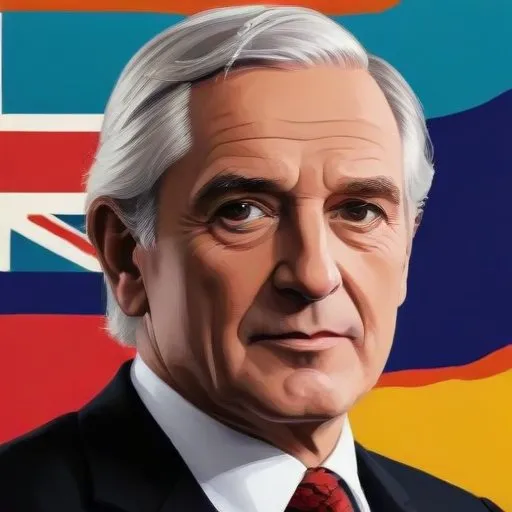
A lawyer-turned-politician who served as New Zealand's Prime Minister, implementing significant economic and social reforms, including the establishment of the country's welfare state.
Walter Nash, the 27th Prime Minister of New Zealand, is renowned for his instrumental role in shaping the country's economy during the Second Labour Government from 1957 to 1960. As a dedicated politician, Nash's unwavering commitment to Christian socialism and pacifism guided his policy decisions, leaving an indelible mark on New Zealand's history.
Born on February 12, 1882, in the West Midlands, England, Nash arrived in New Zealand in 1909 and soon became an ardent member of the original Labour Party. His journey in politics began in 1919, when he joined the party's executive, driven by his strong beliefs in Anglicanism, Christian socialism, and pacifism.
Nash's remarkable political career spanned over four decades, earning him a reputation as a brilliant organizer and administrator. He was first elected to the House of Representatives in the Hutt by-election of 1929 and went on to serve as the Member of Parliament (MP) for the Hutt electorate for 13 consecutive terms, a record that stands to this day.
Appointed as Minister of Finance in 1935, Nash played a pivotal role in guiding the First Labour Government's economic recovery program during the Great Depression. His astute leadership and expertise navigated the country through the tumultuous period, earning him the distinction of serving the longest period of continuous service as Minister of Finance – 14 years.
During World War II, Nash directed the government's wartime controls, demonstrating his exceptional ability to manage crisis situations. His fiscal prudence and vision laid the foundations for New Zealand's economic growth and stability in the post-war era.
In 1951, Nash succeeded Peter Fraser as the leader of the Labour Party and Leader of the Opposition. His moderate approach to governance was often criticized by the left wing of the party, who saw him as too cautious in his approach to social and economic reforms.
Despite these criticisms, Nash's leadership culminated in the Labour Party's narrow victory in the 1957 election, propelling him to the Prime Ministership. Although his tenure was marked by controversy, particularly during the 1951 Waterfront Dispute and the 1960 rugby tour of South Africa, Nash remained committed to his vision of a more equitable and just society.
Walter Nash's enduring legacy is a testament to his unwavering dedication to public service and his commitment to creating a better New Zealand. His significant contributions to the country's economic development, coupled with his passion for social justice, have left an indelible mark on the nation's history.
As a leader, Nash embodied the values of Christian socialism and pacifism, inspiring generations of politicians and citizens alike. His remarkable journey serves as a reminder of the power of vision, dedication, and perseverance in shaping a nation's destiny.
"The Labour Party is not a party of revolution, but a party of reform."
"Our aim is to create a society in which every individual has the opportunity to develop his or her full potential."
These quotes reflect Nash's commitment to gradual, incremental change and his vision of a more equitable society.
Born in 1893
Led the country through a period of significant economic growth and social change, implementing policies that shaped modern New Zealand. He's remembered for his strong leadership and nation-building efforts.
Born in 1904
A farmer-turned-politician who served as Prime Minister of New Zealand, known for his leadership during a period of significant economic and social change. He's remembered for his pragmatic and consensus-driven approach to governance.
74 Years Old
A renowned cancer researcher and professor who made significant contributions to the understanding and treatment of cancer, particularly in the field of p53 tumor suppressor gene.
91 Years Old
The 35th Prime Minister of New Zealand, serving from 1990 to 1997, known for leading the country through significant economic reforms and free trade agreements. He's also recognized for his role in shaping New Zealand's modern economy.
74 Years Old
The first female Prime Minister of New Zealand, serving from 1997 to 1999, known for her conservative economic policies and reform efforts. She played a significant role in shaping the country's social and economic landscape.
76 Years Old
The first female Prime Minister of New Zealand, serving three consecutive terms from 1999 to 2008, known for her progressive policies and commitment to social justice.
77 Years Old
Leader of the New Zealand Labour Party, serving as Prime Minister from 1990 to 1991, known for his strong union background and advocacy for workers' rights.
84 Years Old
The 33rd Prime Minister of New Zealand, serving from 1989 to 1990, known for his leadership during a period of significant economic and social reform in the country. He played a crucial role in shaping New Zealand's modern economy and society.
