


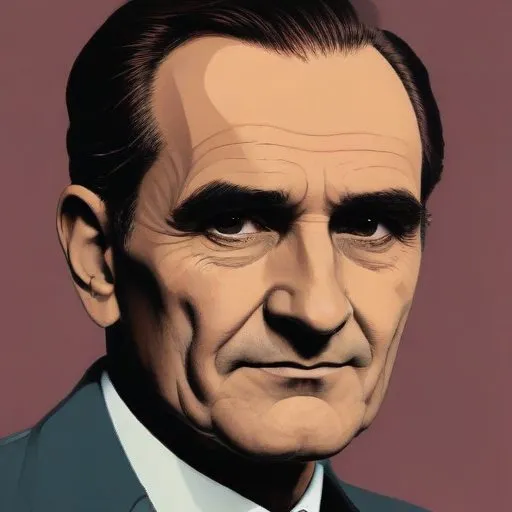
A pioneering physiologist who discovered the role of the brain's diencephalon in regulating bodily functions, earning him a Nobel Prize in Physiology or Medicine in 1949.
Walter Rudolf Hess, a Swiss physiologist, is renowned for his groundbreaking work in mapping the areas of the brain responsible for controlling internal organs, earning him the Nobel Prize in Physiology or Medicine in 1949. Sharing the honor with Egas Moniz, Hess's pioneering research opened up new avenues for understanding the intricate connections between the brain and the body.
Born on March 17, 1881, in Frauenfeld, Switzerland, Hess was the second of three children to Clemens and Gertrud Hess. His father, an advocate for scientific pursuits, encouraged Hess to explore the world of science, and together they conducted experiments in his father's physics laboratory.
Hess began his medical studies in Lausanne in 1899, later moving to Berlin, Kiel, and Zurich, where he received his medical degree from the University of Zurich in 1906. During this time, he developed a viscosimeter to measure blood viscosity, publishing his dissertation titled "Zum Thema Viskositt des Blutes und Herzarbeit" in 1906.
In 1907, Hess moved to the University of Zurich to study under Otto Haab, becoming an ophthalmologist and opening his own private practice in Rapperswil, Switzerland. It was during this period that he developed the Hess screen, a tool used to measure visual perception.
In 1912, Hess left his lucrative private practice to pursue research under Justus Gaule, habilitating in 1913 to become a Privatdozent. His primary interests shifted to the regulation of blood flow and respiration, leading him to spend a year at the Physiological Institute of the University of Bonn under Max Verworn during World War I.
In 1916, Gaule retired, and Hess became the interim director of the Department of the Physiological Institute at the University of Zurich. He served as a full professor and director of the institute from 1917 until his retirement in 1951.
during the 1930s, Hess began mapping the parts of the diencephalon that control internal organs using cats. This research, which culminated in his Nobel Prize win in 1949, has had a profound impact on our understanding of the brain's role in regulating bodily functions.
Walter Rudolf Hess's remarkable contributions to our understanding of the brain's internal workings have left an indelible mark on the scientific community. His pioneering research and legacy continue to inspire new generations of scientists and medical professionals, shaping the course of human knowledge and innovation.
Born in 1890
Pioneering researcher in the fields of psychology and neuroscience, known for his work on the neural basis of behavior, memory, and learning. His findings greatly advanced our understanding of the brain's role in controlling behavior.
Born in 1924
A Swedish neurophysiologist and academic who discovered the organization and function of the visual cortex, and was awarded the Nobel Prize in Physiology or Medicine in 1981 for his work on the brain's visual system.
Born in 1926
A Nobel Prize-winning neurophysiologist who uncovered the inner workings of the visual cortex, revealing how the brain processes visual information. Their groundbreaking research revolutionized our understanding of the human brain.
96 Years Old
A pioneering neuroscientist and psychiatrist who unraveled the mysteries of memory and learning, earning a Nobel Prize for his groundbreaking work on the physiological basis of memory storage.
Born in 1923
A Swedish pharmacologist and physician who discovered the neurotransmitter dopamine's role in the brain, leading to major breakthroughs in Parkinson's disease treatment.
Born in 1925
A pioneering neuroscientist who uncovered the molecular and cellular mechanisms underlying learning and memory, earning a Nobel Prize in Physiology or Medicine in 2000.
Born in 1909
A pioneering neuroscientist who discovered the growth factor NGF, revolutionizing our understanding of cell growth and development, and leading to major breakthroughs in cancer and neurodegenerative disease research.
Born in 1852
Pioneering neuroscientist and pathologist who discovered the structure of neurons and pioneered the field of neuroscience, earning a Nobel Prize in Physiology or Medicine in 1906.
