


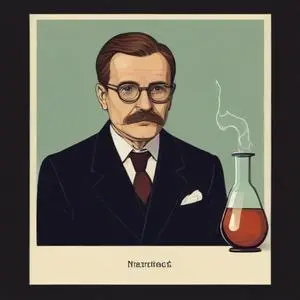
A German chemist and physicist who developed the third law of thermodynamics and made significant contributions to the field of physical chemistry, earning him a Nobel Prize in Chemistry in 1920.
Walther Nernst, a renowned German physicist and physical chemist, is best known for his groundbreaking work in thermodynamics, physical chemistry, electrochemistry, and solid-state physics. His most notable achievement is the formulation of the Nernst heat theorem, which paved the way for the third law of thermodynamics and earned him the 1920 Nobel Prize in Chemistry.
Nernst was born on June 25, 1864, in Briesen, West Prussia (now Wąbrzeźno, Poland) to Gustav Nernst and Ottilie Nerger. He was the fourth of five children, with three older sisters and one younger brother. After completing his elementary education at Graudenz (now Grudziądz), Nernst pursued higher education in physics and mathematics at the universities of Zurich, Berlin, Graz, and Würzburg.
In 1887, Nernst developed the Nernst equation, a fundamental concept in electrochemistry that relates the reduction potential of a half-cell to the standard electrode potential, temperature, and reaction quotient. This equation remains a cornerstone of electrochemical reactions and is widely applied in various fields, including energy storage and conversion.
During his time at the University of Graz, Nernst worked under the direction of Albert von Ettinghausen and discovered the Ettingshausen and Nernst effects. These phenomena describe the interaction between magnetic fields, temperature gradients, and electrical currents in metallic conductors, providing valuable insights into the behavior of materials under different conditions.
Nernst's professional career began as an assistant to Wilhelm Ostwald at the University of Leipzig, where he worked on the thermodynamics of electrical currents in solutions. He later became a lecturer and continued to contribute significantly to the field of physical chemistry.
Some of Nernst's notable works include:
In recognition of his outstanding contributions to the field of chemistry, Nernst was awarded the:
Walther Nernst's pioneering work has had a profound impact on the development of modern physical chemistry, electrochemistry, and solid-state physics. His contributions have paved the way for numerous breakthroughs in fields such as energy storage, advanced materials, and nanotechnology.
Nernst's legacy extends beyond his scientific achievements, as he has inspired generations of scientists and researchers to pursue careers in the physical sciences. His work continues to influence contemporary research, ensuring his place as one of the most influential scientists of the 20th century.
Born in 1879
A brilliant physicist who developed the theory of relativity and is considered one of the most influential scientists of the 20th century, known for his groundbreaking work in physics and mathematics.
Born in 1867
A pioneering scientist who pioneered radioactivity research, discovering elements polonium and radium, and paving the way for breakthroughs in medicine and energy.
Born in 1885
A pioneer in quantum mechanics, he introduced the concept of wave-particle duality, revolutionizing our understanding of atomic structure. His philosophical approach to science also explored the nature of reality and human understanding.
Born in 1858
A pioneer in quantum theory, he introduced the concept of the Planck constant, revolutionizing our understanding of energy and matter.
Born in 1871
A pioneer in nuclear physics, he discovered the nucleus of an atom and developed the Rutherford model, revolutionizing our understanding of the atomic structure.
Born in 1879
A pioneering nuclear chemist who discovered nuclear fission, a process that releases massive energy from atomic nuclei, and was awarded the Nobel Prize in Chemistry in 1944.
Born in 1878
Pioneering physicist who made groundbreaking contributions to nuclear physics, including the discovery of nuclear fission, and was the first woman to become a full professor of physics in Germany.
