


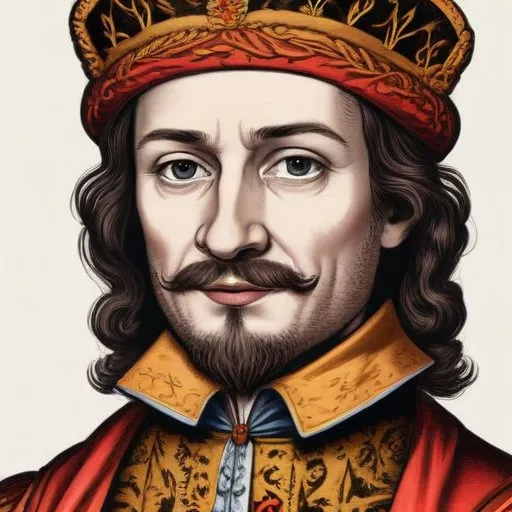
A Czech-English painter and illustrator renowned for his meticulous and detailed etchings of landscapes, architecture, and everyday life in 17th-century Europe. His works offer a unique glimpse into the past, providing valuable historical and cultural insights.
Wenceslaus Hollar, a Bohemian graphic artist of the 17th century, is renowned for his exquisite engravings and etchings that capturing the essence of landscapes, architecture, and scenes from everyday life. With a prolific career spanning over four decades, Hollar's works continue to mesmerize art enthusiasts and historians alike, offering a unique glimpse into the cultural and historical context of his time.
Born on July 23, 1607, in Prague, Hollar's early life was marked by uncertainty and turmoil. The Sack of Prague during the Thirty Years' War led to the ruin of his family, prompting the young Hollar to abandon his plans for a legal career and pursue art instead. The earliest of his works, dated 1625 and 1626, showcase his talent and demonstrate the influence of Albrecht Dürer, a German painter and engraver.
Between 1627 and 1630, Hollar honed his skills under the guidance of Matthus Merian, a renowned engraver, in Frankfurt. During this period, he created several small plates, including a copy of Dürer's Virgin and Child. Hollar's subsequent travels to Strasbourg, Mainz, and Koblenz in 1630 allowed him to capture the charm of the Middle Rhine Valley's landscapes and architecture.
In 1636, Hollar's talent caught the attention of Thomas Howard, the 21st Earl of Arundel, who was on a diplomatic mission to the imperial court of Emperor Ferdinand II. Employed as a draftsman, Hollar accompanied Arundel to Vienna and Prague, where he published his first book in 1635. In 1637, he traveled with Arundel to England, becoming an integral part of the earl's household for many years.
Although Hollar remained an artist in Arundel's service, he worked for various authors and publishers, eventually becoming his primary means of distribution. After Arundel's death in 1646, Hollar continued to produce exceptional works, including commemorative prints, such as the one etched in memory of the earl.
Hollar's prolific career has left an indelible mark on the world of graphic art. His works, numbering over 7,000, offer a unique glimpse into the cultural, historical, and architectural landscape of 17th-century Europe. His influence can be seen in the works of later artists, and his contribution to the development of engraving and etching techniques continues to inspire art enthusiasts and practitioners alike.
Wenceslaus Hollar's remarkable life and career serve as a testament to his dedication to his craft and his role as a pioneering figure in the world of graphic art.
Born in 1599
A renowned Flemish-English painter and etcher, famous for capturing the essence of 17th-century European aristocracy through his exquisite portraits, characterized by dramatic lighting and subtle emotional depth.
Born in 1577
A renowned Flemish painter and diplomat, famous for his vivid and emotive Baroque-style masterpieces, particularly his lush nudes and dramatic altarpieces.
Born in 1471
A Renaissance master of intricate woodcuts and engravings, known for precise and detailed depictions of nature and human form, influencing art and mathematics for centuries.
Born in 1632
A master of capturing intimate, serene domestic scenes, particularly of women, in exquisite detail and soft, luminous light. His works evoke a sense of quiet contemplation and everyday beauty.
Born in 1746
A visionary artist who pioneered Romanticism, capturing the human experience through bold, emotionally charged paintings and sculptures that continue to inspire and unsettle.
