


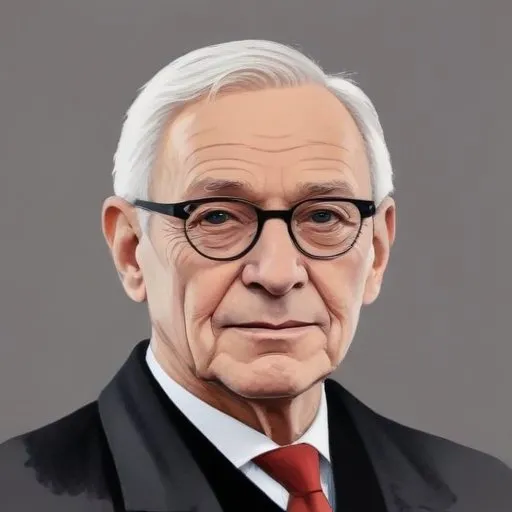
A German economist and sociologist who developed the concept of "late capitalism" and wrote extensively on the rise of modern capitalism, particularly in relation to the development of technology and social classes.
Werner Sombart, a German economist, historian, and sociologist, is renowned for coining the term "late capitalism" and introducing the concept of "creative destruction" associated with capitalism. His magnum opus, Der moderne Kapitalismus, published in three volumes from 1902 to 1927, is a seminal work that outline the evolution of capitalism in four stages: protocapitalism, early capitalism, high capitalism, and late capitalism.
Sombart was born on January 19, 1863, in Ermsleben, Harz, to a wealthy liberal politician, industrialist, and estate owner, Anton Ludwig Sombart. He pursued law and economics at the universities of Pisa, Berlin, and Rome, later earning his Ph.D. from Berlin University in 1888 under the guidance of Gustav von Schmoller and Adolph Wagner.
Sombart's early work as an economist and social activist led him to be perceived as radically left-wing. Despite his exceptional skills, he only received a junior professorship at the University of Breslau due to government vetoes on his appointments to prominent universities like Heidelberg and Freiburg. Sombart was an ardent Marxian, earning praise from Friedrich Engels, who acknowledged him as the only German professor who understood Das Kapital. However, Sombart later criticized Marx, admitting that Marx had made mistakes on several crucial points.
Sombart's Der moderne Kapitalismus is a comprehensive analysis of capitalism, outlining its development from its earliest forms to the late capitalism of the post-World War I period. His work introduced the concept of creative destruction, which describes the process of innovation and destruction that drives capitalist economies.
In addition to his magnum opus, Sombart wrote extensively on socialism, economics, and sociology, leaving a lasting impact on the field of social sciences.
Sombart's work has had a profound influence on modern society, shaping our understanding of capitalism and its evolution. His concept of late capitalism continues to be relevant in contemporary debates on economic systems and their consequences.
Werner Sombart's contributions to the field of economics, sociology, and history have left an indelible mark on our understanding of capitalism and its evolution. His work continues to inspire scholars and thinkers, offering valuable insights into the complexities of modern economic systems.
Sombart's legacy extends beyond his academic writings, influencing generations of intellectuals and shaping the course of social sciences. His work remains a testament to his groundbreaking ideas and his unwavering commitment to understanding the intricacies of human societies.
Born in 1864
Developed the concept of "social action" and is known for his theories on bureaucracy, capitalism, and the role of religion in shaping society.
Born in 1883
A pioneer of innovation theory, he's credited with coining the term "creative destruction" to describe how new technologies and businesses disrupt existing ones, driving economic growth and progress.
Born in 1886
Austro-Hungarian economist and historian who challenged traditional economic thought with his concept of "embedded economy," arguing that economic systems are shaped by social and cultural factors. He's most known for his book "The Great Transformation," which critiques the rise of market societies.
Born in 1899
Austrian economist and philosopher who championed free market capitalism and limited government intervention, warning of the dangers of socialism and totalitarianism. His work influenced economic policy and shaped modern libertarian thought.
Born in 1912
A Nobel Prize-winning economist who championed free market capitalism and limited government intervention, known for his advocacy of laissez-faire economics and influential writings on monetary policy.
Born in 1883
A pioneering economist who revolutionized modern economic theory with his groundbreaking ideas on government intervention and fiscal policy, shaping global economic policies.
Born in 1881
A pioneer of Austrian economics, he developed the concept of praxeology, which focuses on human action and its consequences, and is known for his critiques of socialism and central planning.
