


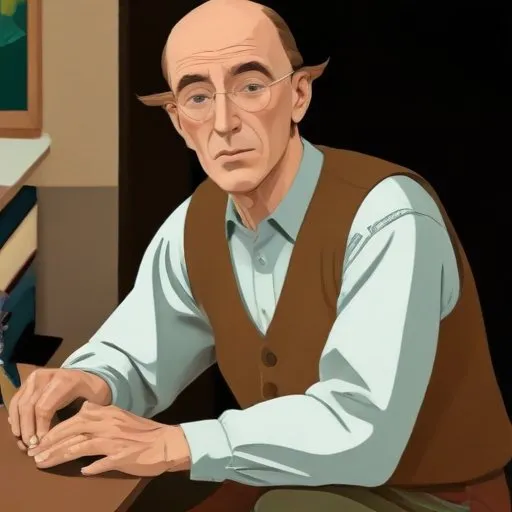
A pioneer of non-traditional sculpting techniques, he crafted intricate, organic forms that blurred the line between art and furniture, earning him a reputation as the "Dean of American Craftsmen".
Wharton Esherick was a renowned American sculptor who revolutionized the world of furniture making by applying the principles of sculpture to everyday objects. He is best known for his iconic, sculptural furniture and furnishings that blurred the lines between art and functionality.
Born on July 15, 1887, in Philadelphia, Pennsylvania, Esherick studied at the Pennsylvania Museum School of Industrial Art (now the University of the Arts) and the Pennsylvania Academy of the Fine Arts. In 1912, he married Leticia Nofer, and the couple moved to a farmhouse in Malvern, Pennsylvania, to pursue a self-sufficient lifestyle inspired by the progressive education movement.
It was during a visit to the Marietta Johnson School of Organic Education in Fairhope, Alabama, in 1919 that Esherick was encouraged to explore woodcarving. He began by creating decorative frames for his paintings, which eventually led to making woodcut prints and, finally, sculpture. This marked the beginning of his journey as a master craftsman.
Esherick's early furniture was deeply rooted in the Arts and Crafts style, characterized by intricate surface carving. However, in the late 1920s, he abandoned surface carving, instead focusing on the pure form of the pieces as sculpture. This shift in style was influenced by the organicism of Rudolf Steiner, as well as German Expressionism and Cubism.
Esherick's work had a profound impact on the development of modern craftsmanship. He is regarded as the dean of American craftsmen, and his influence can be seen in the work of contemporary artisans, particularly in the Studio Craft Movement. His home and studio in Malvern, Pennsylvania, are now part of the Wharton Esherick Museum, which has been listed as a National Historic Landmark since 1993.
Esherick's work was deeply rooted in the principles of the progressive education movement, which emphasized self-sufficiency, craftsmanship, and a connection with nature. He believed in the importance of living a holistic life, where art and functionality merged to create something truly beautiful.
Wharton Esherick's life was a testament to his unwavering dedication to his craft. Through his work, he inspired generations of artisans and craftsmen, leaving behind a legacy that continues to inspire and awe us today.
Wharton Esherick's contribution to the world of craftsmanship is immeasurable. His innovative approach to sculpture and furniture making continues to influence artists and designers around the world. As we look back on his remarkable life's work, we are reminded of the power of creativity, passion, and dedication.
97 Years Old
A pioneering abstract expressionist artist, known for her innovative "soak-stain" technique, which involved pouring thinned paint onto raw canvas to create vibrant, lyrical works. Her style blurred the lines between painting and printmaking.
Born in 1923
A pioneer of Pop Art, creating provocative and humorous works that blended high and low culture, often incorporating found objects and everyday imagery.
Born in 1925
A pioneer of pop art, combining found objects and images to create innovative, thought-provoking works that blurred the lines between art and everyday life.
Born in 1892
A pioneering American modernist, blending cubism and abstract expressionism to create vibrant, jazz-inspired paintings that explored the intersection of art and everyday life.
Born in 1904
A pioneering abstract expressionist, this artist's bold, emotive works blended surrealism and cubism, influencing a generation of artists. Known for their vibrant, dreamlike paintings that explored the human experience.
Born in 1885
A pioneer of American modernism, this artist's bold, flat forms and vibrant colors paved the way for Abstract Expressionism. Their work bridges representation and abstraction, exploring the emotional depth of everyday life.
