


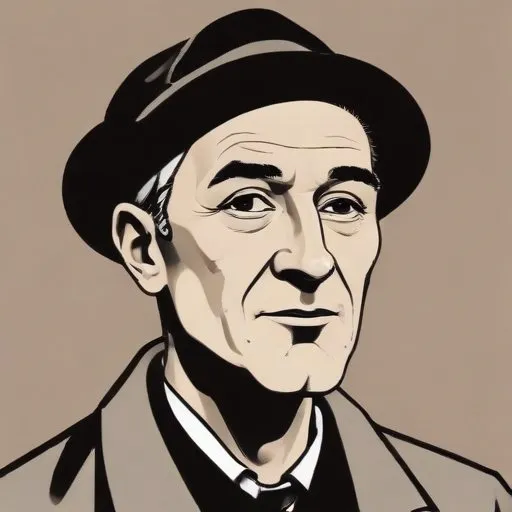
A Victorian-era poet and activist who championed Arab nationalism and wrote passionate verses about love, politics, and social justice.
Wilfrid Scawen Blunt was a multifaceted personality - an English poet, writer, and horse breeder who left an indelible mark on the world of literature and equine breeding. He is best known for his poetry, which appeared in a collected edition in 1914, and his pioneering work in preserving the Arabian horse bloodlines through his farm, the Crabbet Arabian Stud.
Blunt was born on August 17, 1840, at Petworth House in Sussex, to Francis Scawen Blunt and Mary Chandler. He was educated at Twyford School, Stonyhurst, and at St Mary's College, Oscott. During his early years, he served in the Diplomatic Service from 1858 to 1869.
Blunt's love for travel and adventure took him to exotic lands, including Spain, Algeria, Egypt, the Syrian Desert, and India. He married Lady Anne Noel in 1869, and together they co-founded the Crabbet Arabian Stud, which became a pioneering institution for preserving the purebred Arabian horse bloodlines. Their travels also took them to Egypt and the Nejd, where they acquired horses that would form the foundation of their breeding operation.
Blunt's fascination with Islam led him to become immersed in its reformist strands. He was deeply influenced by the ideas of Jamal al-Din al-Afghani, a renowned Islamic reformer. This influence is reflected in his writings, which often expressed anti-imperialist views that were uncommon in his time.
In 1882, Blunt championed the cause of Urabi Pasha, an Egyptian nationalist who led a rebellion against the British-backed Khedive Ismail Pasha. This act of defiance against imperialism cemented Blunt's reputation as a vocal critic of colonialism.
Throughout his life, Blunt wrote extensively on poetry, politics, and horse breeding. His poetry collection, published in 1914, is a testament to his literary prowess. The Crabbet Arabian Stud, which he co-founded with his wife, remains a legendary institution in the world of horse breeding, thanks to its commitment to preserving the purity of the Arabian horse breed.
Blunt's personal life was marked by episodes of faith and doubt. He was raised a Catholic, but later became an atheist, only to undergo episodes of faith. His philosophical contributions include his advocacy for Islamic reform and his critique of imperialism. His life was a testament to the power of adventure, intellectual curiosity, and a commitment to values that transcended borders and empires.
Blunt's life was a rich tapestry of adventure, intellectual pursuits, and a commitment to values that continue to inspire us today. As we reflect on his legacy, we are reminded of the power of human curiosity, creativity, and a willingness to challenge the status quo.
Born in 1821
A 19th-century explorer who ventured into uncharted territories, mapping Africa's Nile River and uncovering hidden cities, earning a reputation as a daring adventurer and scholar.
Born in 1837
A prominent Victorian-era writer, known for his poetic works that explored themes of beauty, death, and the human condition, with a distinctive style that blended sensuality and symbolism.
Born in 1828
A Victorian-era poet and painter who founded the Pre-Raphaelite Brotherhood, creating dreamlike, sensual works that explored themes of love, beauty, and mortality.
Born in 1830
A renowned Victorian-era poet and author, celebrated for her lyrical and symbolic poetry, particularly "The Goblin Market and Other Poems" and "The Prince's Progress".
Born in 1834
A renowned artist and writer who revolutionized the Arts and Crafts movement with his stunning textiles, poetry, and novels, leaving a lasting impact on Victorian-era aesthetics.
Born in 1833
A leading figure in the Pre-Raphaelite movement, creating dreamlike, romantic, and mythological paintings that captivated the Victorian era. His works continue to inspire artists, designers, and writers to this day.
