


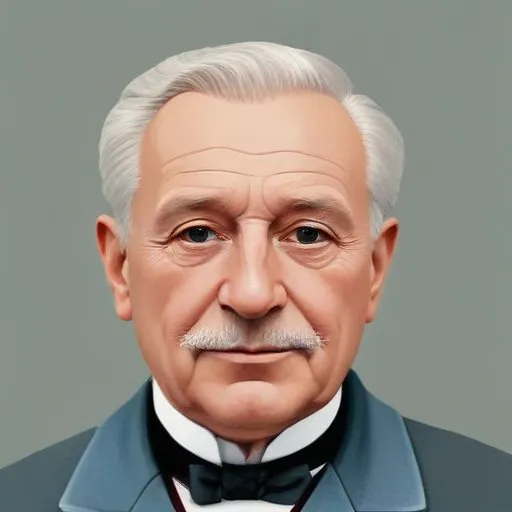
A pioneering botanist who discovered the alternation of generations in plants, and is considered the father of plant morphology.
Wilhelm Hofmeister, a German biologist and botanist, is renowned for his groundbreaking discovery of the alternation of generations in plants, a concept that transformed our understanding of plant evolution and reproduction. His work, which spanned over three decades, laid the foundation for modern plant biology, earning him a place alongside other luminaries like Charles Darwin and Gregor Mendel.
Born on May 18, 1824, in Leipzig, Germany, Hofmeister was the son of a book and music publisher. He left vocational high school at the age of 15 to apprentice in a bookshop in Hamburg, where he developed a strong interest in science and nature. Despite lacking formal education in biology, Hofmeister's self-taught skills and dedication earned him recognition in the scientific community.
Hofmeister's most notable work, "Vergleichende Untersuchungen über die Keimung, Entfaltung und Fruchtbildung höherer Kryptogamen und der Samenbildung der Coniferen" (Comparative Investigations on the Germination, Development, and Fruit Formation of Higher Cryptogams and the Seed Formation of Conifers), published in 1851, details his discovery of the alternation of generations in plants. This work earned him an honorary doctorate from the University of Rostock in the same year.
His research, conducted largely in his spare time, typically between 4 am and 6 am before starting his workday, spanned multiple areas, including the study of bryophytes, ferns, and conifers. Hofmeister's findings on the sexual reproduction of plants and the role of spores and gametophytes in plant life were instrumental in shaping the field of botany.
Hofmeister married Muriel Agnes Lurgenstein in 1847, with whom he had nine children. He was also a freemason, initiated at Lodge Apollo in Hamburg in 1847. After the death of his first wife in 1870, Hofmeister married Johanna Schmidt in 1876.
Hofmeister's discovery of the alternation of generations in plants has had a lasting impact on the field of botany, shaping our understanding of plant evolution and reproduction. His work paved the way for future generations of botanists, influencing the development of modern plant biology and ecology.
Through his tireless efforts and contributions to the scientific community, Wilhelm Hofmeister has left an indelible mark on the world of biology, cementing his place as one of the most important figures in the history of the field.
Born in 1809
Developed the theory of evolution through natural selection, revolutionizing our understanding of life on Earth. This groundbreaking idea transformed the fields of biology, ecology, and beyond.
Born in 1822
An Austrian monk who pioneered genetics by experimenting with pea plants, discovering the fundamental laws of heredity, and laying the foundation for modern genetics.
Born in 1744
A French soldier, biologist, and academic who developed a theory of inheritance of acquired characteristics, proposing that organisms adapt to their environment and pass on those traits to their offspring.
Born in 1743
A British naturalist who sailed with Captain Cook on the HMS Endeavour, discovering and cataloging thousands of plant species, and advising on the development of the British colonies. He's considered the "father of Australian botany".
Born in 1707
Developed the system of binomial nomenclature, which is still used today to classify and name living organisms. This system has had a profound impact on the fields of biology, ecology, and conservation.
82 Years Old
A German-Canadian singer-songwriter, guitarist, and producer, known for his eclectic style blending rock, folk, and blues, and as the frontman of the rock band Steppenwolf. He's famous for hits like "Born to Be Wild" and "Magic Carpet Ride".
Born in 1632
Pioneering microbiologist who discovered microorganisms like bacteria, yeast, and protists, laying the foundation for modern microbiology.
