


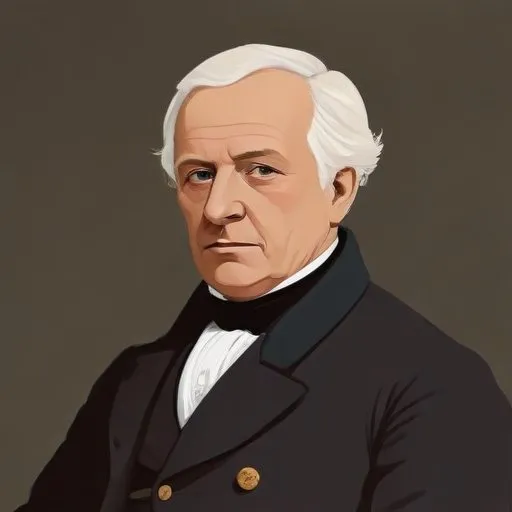
A pioneer in linguistics and education, he advocated for a liberal and inclusive education system, and his ideas shaped the modern university system. He also played a key role in shaping Prussia's government and culture.
Wilhelm von Humboldt, a German philosopher, linguist, government functionary, diplomat, and founder of the Humboldt University of Berlin, is renowned for his groundbreaking contributions to the philosophy of language, ethnolinguistics, and the theory and practice of education. He is particularly celebrated for envisioning education as a means of realizing individual possibility, rather than merely preparing students for a predetermined occupation or social role.
Born on June 22, 1767, in Potsdam, Margraviate of Brandenburg, Wilhelm von Humboldt came from a prominent German noble family from Pomerania. His father, Alexander Georg von Humboldt, was a major in the Prussian Army, who served with the Duke of Brunswick, and later became a royal chamberlain. Wilhelm's mother, Maria Elisabeth Colomb, was a well-educated woman and widow of Baron Friedrich Ernst von Holwede.
Humboldt's philosophical works focused on the concept of humanism, emphasizing the importance of individual freedom, self-expression, and the pursuit of knowledge. He believed that education should foster critical thinking, creativity, and moral responsibility, rather than mere memorization and obedience. His ideas on the nature of language and its relationship to culture and society continue to influence linguistics, anthropology, and philosophy to this day.
Humboldt's vision for education was revolutionary for its time. He argued that education should be a holistic process, aimed at cultivating the whole person, rather than simply preparing students for specific careers or social roles. He advocated for a liberal arts education, which would provide students with a broad-based education in the humanities, social sciences, and natural sciences. This approach would enable individuals to develop their unique talents and perspectives, and contribute to the enrichment of society as a whole.
In 1810, Humboldt was instrumental in founding the University of Berlin, which was later renamed the Humboldt University of Berlin in his honor. The university was designed to embody his educational ideals, providing students with a liberal arts education that fostered critical thinking, creativity, and moral responsibility. The university quickly became a model for education in Prussia, and its influence extended to other parts of Europe, the United States, and Japan.
Humboldt's ideas on education and individual development have had a profound impact on modern society. His emphasis on critical thinking, creativity, and moral responsibility has influenced educational systems worldwide. His concept of the university as a place for intellectual inquiry and discovery has shaped the modern research university. Furthermore, his advocacy for individual freedom and self-expression has contributed to the development of liberal democracies.
"True excellence is not a function of the intellect, but of the will."
Humboldt's life and work were shaped by the intellectual and cultural currents of the Enlightenment and the Romantic era. His ideas on education and individual development were influenced by the works of Immanuel Kant, Johann Gottlieb Fichte, and other prominent thinkers of his time. Today, Humboldt's legacy continues to inspire educators, scholars, and policymakers around the world, and his ideas remain a vital part of the ongoing conversation about the purpose and meaning of education.
Born in 1724
Developed influential philosophical frameworks, such as the Critique of Pure Reason, that shaped modern Western thought on ethics, morality, and human understanding.
Born in 1762
A German philosopher and academic who developed the concept of German idealism, emphasizing the role of the individual and the nation in shaping reality. He's known for his influence on German philosophy and the development of existentialism.
Born in 1759
A renowned poet and playwright who crafted influential works that explored the human condition, morality, and the struggle for freedom, leaving a lasting impact on German literature.
Born in 1769
A pioneering geographer and explorer who mapped much of South America and discovered the Caspian Sea's connection to the Black Sea, greatly advancing our understanding of the natural world.
Born in 1770
A German philosopher and academic who developed a comprehensive and systematic philosophy that emphasized the unity of all things and the dialectical process of thesis, antithesis, and synthesis. His ideas have had a profound impact on modern thought, influencing fields such as philosophy, politics, and art.
Born in 1767
A leading figure in the German Romantic movement, he was a poet, translator, and critic who played a key role in shaping the country's literary scene. His translations of Shakespeare's works into German are still widely read today.
Born in 1788
A pessimistic philosopher who wrote about the human condition, emphasizing the struggles and sufferings of life, and is famous for his concept of the "will to life".
Born in 1805
A French diplomat and engineer who developed the Suez Canal, a crucial waterway connecting the Mediterranean Sea to the Red Sea, revolutionizing global trade and commerce.
