


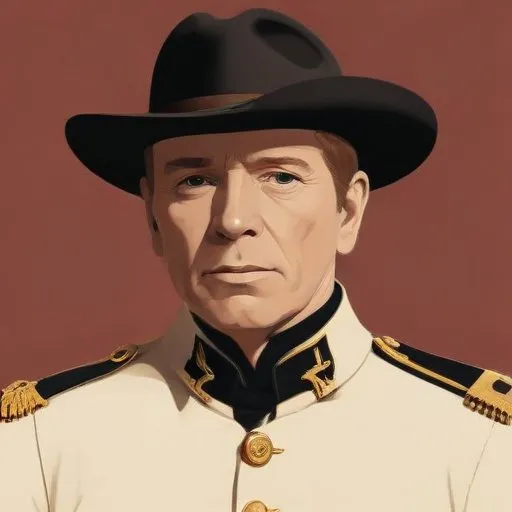
A prominent Union general during the American Civil War, known for his bravery and leadership at the Battle of Shiloh and his role in the Siege of Louisville.
William Bull Nelson, a United States naval officer turned Union general, remains a significant figure in American history for his unwavering loyalty to the Union during the American Civil War. Born in Maysville, Kentucky, on September 27, 1824, Nelson's actions would prove crucial in keeping his home state loyal to the United States, earning him the respect and admiration of his contemporaries.
Nelson was the third and youngest son of Dr. Thomas W. Nelson and Frances Doniphan. He attended Maysville Academy Seminary and later enrolled in Norwich University at the tender age of 13. Two years later, Nelson's preparatory training at the Vermont military school concluded, and he secured an appointment as a midshipman in the US Navy, courtesy of Representative Garrett Davis.
In the spring of 1840, Nelson reported for training aboard the USS Delaware, where he spent the next five years sailing the South Pacific. He then joined the first class to attend the newly established Naval Academy at Annapolis, Maryland. On July 11, 1846, Nelson became a passed midshipman and reported for duty aboard the USS Raritan, the flagship for the Home Squadron in the Gulf of Mexico.
At the outbreak of the American Civil War, Nelson's loyalty to the Union was unwavering, unlike many of his fellow Kentuckians. His actions earned him the respect of Secretary of the Treasury Salmon P. Chase, who believed Nelson's efforts had kept Kentucky loyal to the United States. In September 1861, Nelson was promoted to brigadier general, becoming the first naval officer to achieve this rank.
As a general, Nelson's 4th Division bore the brunt of heavy fighting at the Battle of Shiloh and took part in the Siege of Corinth. He was the first man to enter the town of Corinth, a testament to his bravery and leadership.
Nelson's life was cut short in a tragic incident involving fellow Union general Jefferson C. Davis. Wounded at the Battle of Richmond, Nelson was forced to retreat to Louisville to plan a new assault. It was there that Davis, still officially on sick leave, reported to Nelson, who was dissatisfied with his performance and insulted him in front of witnesses.
A few days later, Davis demanded a public apology, but the situation rapidly escalated into a physical confrontation, which concluded in Davis mortally wounding Nelson with a pistol on September 29, 1862.
William Bull Nelson's bravery, loyalty, and leadership during the American Civil War have left an indelible mark on American history. His actions kept Kentucky loyal to the United States, and his contributions to the Union war effort were significant. Today, Nelson is remembered as a hero who gave his life in service to his country.
William Bull Nelson's story serves as a testament to the bravery and loyalty of those who fought to preserve the Union during the American Civil War. His legacy continues to inspire Americans to this day, and his contributions to the war effort will never be forgotten.
Born in 1822
Led the Union Army to victory in the Civil War and later became President, known for issuing the Emancipation Proclamation and strengthening federal authority.
Born in 1820
A renowned Union general during the American Civil War, he's infamous for his scorched earth tactics and march through the Confederacy, leaving destruction in his wake.
Born in 1826
A Union general during the American Civil War, he's infamous for his cautious tactics and disagreements with President Lincoln, later becoming a governor of New Jersey.
Born in 1824
A Union general during the American Civil War, known for his distinctive sideburns and leading the Army of the Potomac to a disastrous defeat at the Battle of Fredericksburg.
Born in 1814
Union general who played a crucial role in the American Civil War, particularly at the Battle of Chancellorsville and Gettysburg.
Born in 1815
Led the Union Army to victory in the Battle of Gettysburg, a turning point in the American Civil War, and later oversaw the construction of the Washington Aqueduct.
Born in 1815
A prominent Union general during the American Civil War, he played a crucial role in the war's western theater and later served as General-in-Chief of all Union armies. He's also known for his scholarly writings on international law.
