


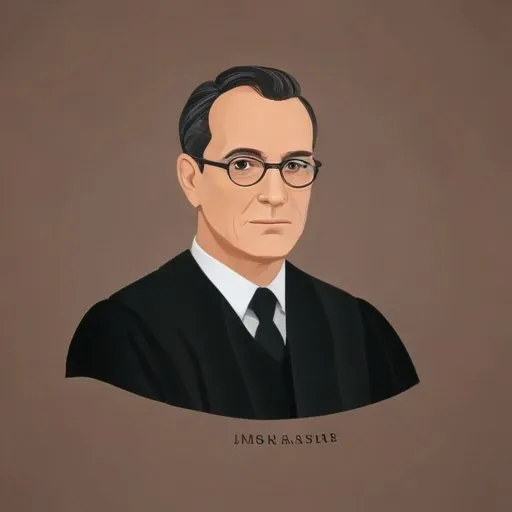
One of the original six justices appointed to the US Supreme Court, he served for 21 years and wrote over 600 opinions, shaping the country's early legal landscape.
William Cushing, one of the original five associate justices of the United States Supreme Court, served for an impressive 20 years and 11 months, making his tenure the longest among the Court's inaugural members. He was a pioneer in the American judiciary, leaving an indelible mark on the country's legal landscape.
Born on March 1, 1732, in Scituate, Massachusetts Bay, Cushing came from a family with a rich history in the area. His father, John Cushing, was a provincial magistrate who later became an associate justice of the Superior Court of Judicature. Cushing's grandfather, also John Cushing, was a superior court judge and member of the governor's council.
Cushing's early education was overseen by his father and Richard Fitzgerald, a teacher at a local Latin school. He graduated from Harvard College in 1751 and became a member of the bar of Boston in 1755. After brief stints practicing law in Scituate and Pownalborough (present-day Dresden, Maine), he became the first practicing attorney in the province's eastern district.
In 1762, Cushing was called to become a barrister, again the first in Maine. He practiced law until 1772, when he was appointed by Governor Thomas Hutchinson to replace his father on the Superior Court bench. This marked the beginning of Cushing's illustrious career in the judiciary.
In 1789, Cushing was confirmed by the United States Senate as an associate justice of the Supreme Court, a position he held until his death in 1810. During his tenure, he played a crucial role in shaping the Court's decisions, particularly in cases involving property rights and state sovereignty.
William Cushing's contributions to American jurisprudence are immeasurable. He played a vital role in establishing the Supreme Court as a coequal branch of government, and his opinions continue to shape the country's legal landscape to this day.
As a testament to his enduring legacy, Cushing's commitment to the principles of justice and fairness continues to inspire generations of lawyers, judges, and legal scholars.
Born in 1755
The 4th Chief Justice of the United States Supreme Court, a leading figure in shaping the country's judiciary system and interpreting its Constitution, is renowned for establishing the principle of judicial review. This legacy has had a lasting impact on American law and politics.
Born in 1777
The 5th Chief Justice of the United States, who delivered the infamous Dred Scott decision, ruling that African Americans were not citizens and had no right to sue in court. He's infamous for perpetuating slavery and racism in the US.
Born in 1808
The 6th Chief Justice of the United States, a strong advocate for slavery abolition and a key player in shaping the country's financial system, particularly during the Civil War era.
Born in 1856
A pioneering lawyer and jurist who championed individual rights and freedoms, shaping the course of American law and democracy through landmark Supreme Court decisions.
Born in 1882
A renowned Supreme Court Justice and Harvard Law professor who played a significant role in shaping American law and policy, particularly in the areas of civil liberties and judicial restraint.
Born in 1886
A U.S. Supreme Court Justice who served for 34 years, known for his strong support of individual liberties and First Amendment rights.
Born in 1898
A Supreme Court Justice who championed individual rights and environmental protection, leaving a lasting impact on American law and conservation.
Born in 1908
A trailblazing lawyer and civil rights champion who broke racial barriers in the US justice system, serving as the first African American on the Supreme Court. He fought tirelessly for equality and justice, leaving a lasting impact on American history.
