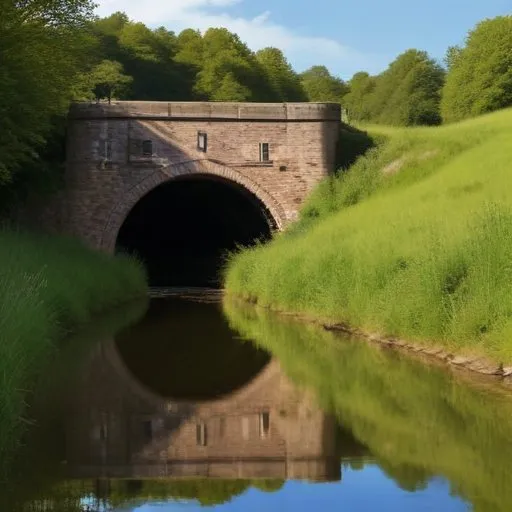
William Jessop: The Pioneering Civil Engineer
A Legacy of Innovation in Canal, Harbour, and Railway Engineering
William Jessop, a renowned English civil engineer, left an indelible mark on the landscape of 18th and 19th century infrastructure development. He is best known for his groundbreaking work on canals, harbours, and early railways, revolutionizing the way goods and people moved across the nation.
The Formative Years
Born on January 23, 1745, in Devonport, Devon, Jessop's early life was deeply rooted in the naval dockyard where his father, Josias Jessop, worked as a foreman shipwright. The elder Jessop's responsibility for maintaining Rudyerd's Tower, a wooden lighthouse on the Eddystone Rock, would have a profound impact on William's future. When the lighthouse burned down in 1755, Josias oversaw the construction of a new stone lighthouse, designed by
John Smeaton, a prominent civil engineer. This chance encounter sparked a lifelong connection between Smeaton and Jessop, with the latter becoming Smeaton's pupil and protégé.
Rise to Prominence
Under Smeaton's guidance, Jessop honed his skills, working as his assistant on various canal schemes in Yorkshire. He assisted Smeaton with the Calder and Hebble and the Aire and Calder navigations, gaining invaluable experience that would serve him well in his future endeavors. As he matured as an engineer, Jessop began to strike out on his own, taking on increasingly complex and prestigious projects.
The Grand Canal of Ireland
One of Jessop's most notable achievements was his work on the Grand Canal of Ireland. Begun in 1753 as a government project, the canal had languished for 17 years, with only 14 miles of canal constructed from the Dublin end. In 1772, a private company was formed to complete the canal, and Smeaton recommended Jessop as the principal engineer. Jessop's innovative approach and tireless efforts transformed the project, as he resurveyed the proposed line, carried the canal over the River Liffey via the Leinster Aqueduct, and drove the canal across the treacherous Bog of Allen.
Major Projects and Contributions
- Aire and Calder Navigation: Jessop's work on this canal greatly improved navigation and facilitated trade between Leeds and the Humber Estuary.
- Canal du Centre: He played a crucial role in the construction of this French canal, which connected the Atlantic Ocean to the Mediterranean Sea.
- River Thames: Jessop worked on several projects along the River Thames, including the construction of the first canal to link the Thames to the Grand Junction Canal.
- Railway Pioneering: He was involved in the development of early railways, including the Middleton Railway, which was one of the first commercial railways in the world.
Legacy and Impact
William Jessop's contributions to the world of civil engineering are immeasurable. His innovative solutions, meticulous attention to detail, and perseverance in the face of adversity have inspired generations of engineers. As a testament to his legacy, he was elected a Fellow of the Royal Society in 1791 and served as the President of the Institution of Civil Engineers from 1812 to 1814.
A Lasting Testament
Jessop's remarkable career spanned decades, leaving behind a body of work that continues to influence modern engineering practices. His dedication to his craft, his innovative spirit, and his perseverance in the face of adversity serve as a shining example to engineers and innovators alike. As we look back on his remarkable life, we are reminded of the power of human ingenuity and the enduring impact of one man's vision on the world.
FAQ
What was William Jessops main contribution to engineering?
William Jessops main contribution to engineering was his work on canals and waterways, particularly the development of the Cromford Canal. He was a pioneer in the field of civil engineering and helped to shape the course of British transportation.
What were William Jessops key achievements as a civil engineer?
William Jessops key achievements as a civil engineer include his work on the Cromford Canal, the Nottingham Canal, and the Oxford Canal. He was known for his innovative approach to canal design and construction.
How did William Jessops work impact the Industrial Revolution?
William Jessops work on canals and waterways played a crucial role in the Industrial Revolution, facilitating the transportation of goods and raw materials across Britain. His canals helped to stimulate economic growth and development in the region.
What was William Jessops role in the development of the British canal system?
William Jessop played a leading role in the development of the British canal system, working alongside other prominent engineers such as James Brindley and Thomas Telford. He was instrumental in shaping the course of British transportation and commerce.
What is William Jessops legacy in engineering?
William Jessops legacy in engineering is that of a pioneering figure who helped to shape the course of British transportation and commerce. His work on canals and waterways continues to inspire engineers and historians today.