


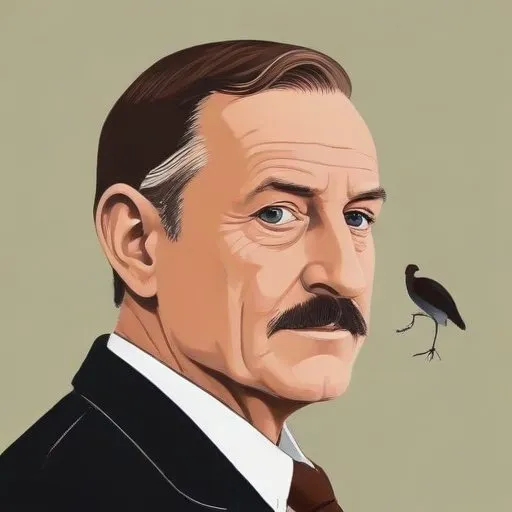
A pioneering naturalist who cataloged and illustrated numerous bird and insect species, significantly advancing the field of ornithology and entomology.
William John Swainson, a renowned English ornithologist, malacologist, conchologist, entomologist, and artist, left an indelible mark on the scientific community with his groundbreaking contributions to the world of natural history. Born on October 8, 1789, in London, England, Swainson's curiosity and passion for the natural world led him to become one of the most prolific collectors and describers of species of his time.
Swainson's journey began in the Liverpool Customs, where he joined as a junior clerk at the tender age of 14. However, his thirst for adventure soon led him to join the Army Commissariat, which took him to Malta and Sicily. During this period, he studied the ichthyology of western Sicily, laying the foundation for his future contributions to the field of natural history.
In 1815, Swainson was forced to return to England due to ill health, but this setback only marked the beginning of his illustrious career. He was elected a fellow of the Linnean Society in the same year, following in the footsteps of his father, John Timothy Swainson.
In 1816, Swainson embarked on a journey to Brazil with the English explorer Henry Koster, where he met Dr. Grigori Ivanovitch Langsdorff, a Russian Consul General and fellow explorer. Although their time on shore was cut short due to a revolution, Swainson returned to England in 1818 with a treasure trove of specimens, including over 20,000 insects, 1,200 species of plants, drawings of 120 species of fish, and about 760 bird skins.
Swainson's contributions to the scientific community earned him numerous accolades, including his election as a fellow of the Royal Society in 1820. He was also a member of the Wernerian Society of Edinburgh and other esteemed learned societies.
Swainson married Mary Parkes in 1823, with whom he had five children. After Mary's untimely death in 1835, he remarried Ann Grasby in 1840 and emigrated to New Zealand. Although Swainson's personal life was marked by tragedy and loss, his scientific legacy continues to inspire generations of naturalists and researchers.
Swainson's work had a profound impact on the fields of ornithology, malacology, conchology, and entomology. He described numerous species of birds, fish, and insects, many of which bear his name. His contributions to the scientific community are a testament to his tireless dedication to the pursuit of knowledge.
William John Swainson's remarkable life and achievements serve as a testament to the power of human curiosity and determination. His contributions to the world of natural history continue to inspire and educate generations of scientists, researchers, and enthusiasts alike.
Born in 1809
Developed the theory of evolution through natural selection, revolutionizing our understanding of life on Earth. This groundbreaking idea transformed the fields of biology, ecology, and beyond.
Born in 1823
A pioneering naturalist who discovered evolution through natural selection, independently of Charles Darwin, and contributed significantly to the field of biogeography.
Born in 1743
A British naturalist who sailed with Captain Cook on the HMS Endeavour, discovering and cataloging thousands of plant species, and advising on the development of the British colonies. He's considered the "father of Australian botany".
41 Years Old
A Welsh rugby union player who captained Wales and the British and Irish Lions, known for his exceptional skill and leadership on the pitch.
Born in 1812
A Portuguese-New Zealand soldier, explorer, and politician who served as the 11th Prime Minister of New Zealand, known for his governance and exploration of the country. He played a significant role in shaping New Zealand's early history.
Born in 1804
A pioneering figure in the fields of biology, anatomy, and paleontology, known for coining the term "Dinosauria" and making significant contributions to our understanding of vertebrate evolution.
Born in 1825
A prominent figure in the scientific community, known for advocating Charles Darwin's theory of evolution and coining the term "agnostic" to describe his own religious views.
Born in 1804
A pioneering ornithologist and illustrator who created vibrant, detailed drawings of birds, contributing significantly to the field of ornithology and inspiring future generations of naturalists.
