


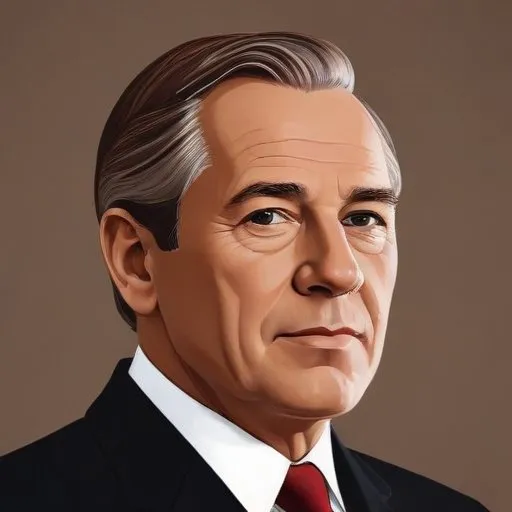
A prominent lawyer and politician who served as Secretary of State, playing a key role in shaping US foreign policy during the late 19th century. He's also known for his defense of President Andrew Johnson during his impeachment trial.
William Maxwell Evarts, a luminary of American politics, etched his name in the annals of history as a skilled litigator, U.S. Secretary of State, U.S. Attorney General, and U.S. Senator from New York. His remarkable career was punctuated by his involvement in three monumental cases that shaped the nation's political jurisprudence.
Born on February 6, 1818, in Charlestown, Massachusetts, Evarts was the son of Jeremiah Evarts, a lawyer and editor of a religious journal, and Mehitabel Barnes Sherman. His mother was the daughter of Roger Sherman, a Connecticut founding father and signatory to the Declaration of Independence, the Articles of Confederation, and the Constitution.
Evarts attended Boston Latin School and later graduated from Yale College, where he was classmates with notable figures such as Morrison Waite, Samuel J. Tilden, Benjamin Silliman Jr., and Edwards Pierrepont.
Evarts' remarkable career was marked by his exceptional skills as a litigator and his commitment to civil service reform. As a member of the Half-Breed faction of the Republican Party, he actively worked to bolster opposition against the spoils system and advocated for the rights of Southern blacks.
During the presidency of Rutherford B. Hayes, Evarts played a crucial role in shaping the nation's political landscape. His involvement in the impeachment of a president, the Geneva arbitration, and the contests before the electoral commission to settle the presidential election of 1876 cemented his reputation as a mastermind of American politics.
Evarts was a fierce advocate for civil service reform and was committed to eradicating the spoils system. He believed in the importance of merit-based appointments and worked tirelessly to promote transparency and accountability in government.
As a staunch supporter of civil rights, Evarts fought for the rights of Southern blacks, recognizing the inherent dignity and worth of every individual. His commitment to social justice and equality left an indelible mark on American politics.
In 1843, Evarts married Helen Minerva Bingham, with whom he had six children. The couple's marriage was marked by mutual respect and admiration, and Helen's influence on Evarts' life and career was profound.
Evarts' father, Jeremiah, died when William was just thirteen, leaving a lasting impact on his life and shaping his future ambitions.
William M. Evarts' remarkable career and contributions have left a lasting impact on American politics and jurisprudence. His commitment to civil service reform, civil rights, and social justice continues to inspire generations of leaders and scholars.
As an eloquent statesman and legal luminary, Evarts' legacy serves as a testament to the power of dedication, hard work, and unwavering commitment to the principles of justice and equality.
"The greatest glory in living lies not in never falling, but in rising every time we fall."
"It is not the critic who counts, not the man who points out how the strong man stumbled, or where the doer of deeds could have done them better. The credit belongs to the man who is actually in the arena."
These words, spoken by William M. Evarts, continue to inspire generations of leaders and individuals, serving as a testament to the power of perseverance, resilience, and determination.
Born in 1809
Led the United States through its Civil War and ultimately abolished slavery, leaving a lasting legacy in American history.
Born in 1822
Led the Union Army to victory in the Civil War and later became President, known for issuing the Emancipation Proclamation and strengthening federal authority.
Born in 1843
The son of President Abraham Lincoln, he served as Secretary of War under President James A. Garfield and later as Ambassador to the United Kingdom, playing a key role in international diplomacy. He was also a successful lawyer and businessman.
Born in 1818
The wife of President Abraham Lincoln, known for her strong personality and her efforts to preserve the White House, as well as her struggles with mental health and grief.
Born in 1800
Abolitionist who led the raid on Harpers Ferry, a pivotal event that helped spark the American Civil War, fighting to end slavery through radical action.
Born in 1808
The President of the Confederate States of America during the American Civil War, leading the secessionist movement and fighting to preserve slavery. He's infamous for his role in the Civil War and its aftermath.
Born in 1808
The 6th Chief Justice of the United States, a strong advocate for slavery abolition and a key player in shaping the country's financial system, particularly during the Civil War era.
