


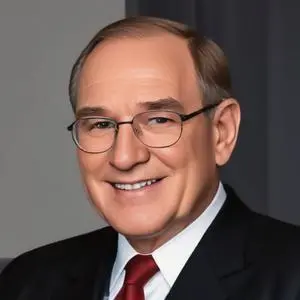
The 16th Chief Justice of the United States, a conservative jurist who led the Supreme Court from 1986 to 2005, shaping the court's decisions on issues like abortion and affirmative action. He's also known for his role in several landmark cases, including Bush v. Gore.
William Hubbs Rehnquist, the 16th Chief Justice of the United States, is renowned for his unwavering conservative stance and instrumental role in shaping the country's judicial landscape. During his 33-year tenure on the Supreme Court, Rehnquist played a pivotal role in shaping the Court's stance on federalism, voting rights, and individual liberties.
Born on October 1, 1924, in Milwaukee, Wisconsin, Rehnquist grew up with a strong academic foundation. He attended Stanford University, where he earned a degree in political science, and later graduated first in his class from Stanford Law School. His academic prowess earned him a coveted spot as an editor of the Stanford Law Review.
During World War II, Rehnquist served in the U.S. Army Air Forces from 1943 to 1946. After the war, he clerked for Justice Robert H. Jackson during the Supreme Court's 1952-1953 term. This experience laid the groundwork for his future judicial career. Rehnquist then entered private practice in Phoenix, Arizona, where he established himself as a skilled lawyer.
In 1969, President Richard Nixon appointed Rehnquist as the U.S. Assistant Attorney General of the Office of Legal Counsel. In this capacity, he played a significant role in forcing Justice Abe Fortas to resign, marking the first time a Supreme Court justice had been forced to step down in over 40 years. In 1971, Nixon nominated Rehnquist to succeed Associate Justice John Marshall Harlan II, and the U.S. Senate confirmed him that year.
Rehnquist's conservative ideology guided his judicial decisions, often leading to contentious debates. Some of his most notable decisions include:
Rehnquist's personal life was marked by controversy, particularly during his confirmation hearings, where he was accused of opposing the Brown v. Board of Education decision and participating in voter suppression efforts targeting minorities. Historians continue to debate whether he committed perjury during these hearings.
William Rehnquist's jurisprudence left an indelible mark on the Supreme Court and American law. His commitment to conservative principles and federalism has influenced generations of jurists and politicians. Despite controversies and criticism, Rehnquist remains a significant figure in American legal history.
Throughout his career, Rehnquist received numerous awards and honors, including the Presidential Medal of Freedom, the highest civilian honor in the United States.
Did you know that Rehnquist was an avid outdoorsman and enjoyed hiking and fishing?
William Rehnquist passed away on September 3, 2005, leaving behind a complex and multifaceted legacy that continues to shape the Supreme Court and American society today.
Born in 1917
A prominent Canadian politician who served as the 17th Premier of Ontario, known for his progressive policies and significant contributions to the province's development.
90 Years Old
A conservative Supreme Court Justice who played a significant role in shaping the court's decisions on issues like abortion, affirmative action, and gun rights, known for his originalist interpretation of the Constitution.
78 Years Old
The longest-serving African American justice on the Supreme Court, known for his conservative views and influential opinions on affirmative action, gun rights, and the death penalty.
93 Years Old
A pioneering Supreme Court Justice and women's rights advocate who championed gender equality and became a cultural icon.
90 Years Old
A Supreme Court Justice who served for over 30 years, known for his swing votes and opinions on landmark cases, including same-sex marriage and abortion rights.
96 Years Old
First female Supreme Court Justice in the United States, serving from 1981 to 2006 and playing a crucial role in many landmark cases, particularly those involving gender equality and reproductive rights.
Born in 1907
The 15th Chief Justice of the United States, leading the Supreme Court from 1969 to 1986, known for his conservative stance and landmark decisions on abortion and capital punishment.
Born in 1844
A Confederate sympathizer who attempted to assassinate Secretary of State William H. Seward on the night President Lincoln was killed, as part of a broader conspiracy. He was a conspirator in the plot to disrupt the US government.
