


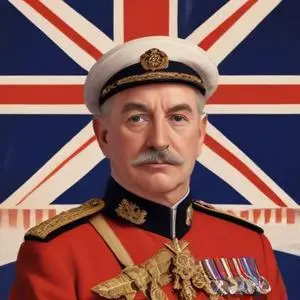
A renowned British military leader who played a crucial role in World War II, particularly in the Burma Campaign, and later served as the Governor-General of Australia. He's also known for his leadership and strategic skills.
Field Marshal William Joseph Slim, 1st Viscount Slim, is renowned for leading the Fourteenth Army, colloquially known as the "Forgotten Army," to victory in the grueling Burma campaign during World War II. As a decorated British military commander, he left an indelible mark on the annals of history, earning the respect and admiration of his peers and the British public alike.
Born on August 6, 1891, in St. Andrews, Bristol, Slim was the son of John Slim and Charlotte Tucker. He was raised in Birmingham, where he attended St. Philips Grammar School and King Edwards School. After completing his education, Slim worked as a teacher and later as a clerk in a metal tube maker's office.
Slim's military career began in 1912 when he joined the Birmingham University Officers Training Corps. He was commissioned as a temporary second lieutenant into the Royal Warwickshire Regiment on August 22, 1914, following the outbreak of World War I. Slim served with distinction, suffering three wounds in action and earning several honors, including the Military Cross.
In the interwar period, Slim continued to serve in the British Army, eventually becoming a staff officer. During World War II, he commanded the 10th Indian Infantry Brigade and later the 14th Indian Infantry Division. Slim's most notable achievement came when he led the Fourteenth Army in the Burma campaign, successfully adapting to the region's harsh terrain and fending off Japanese forces.
After the war, Slim became the first British officer who had served in the Indian Army to be appointed Chief of the Imperial General Staff. In 1953, he was appointed the 13th Governor-General of Australia, a position he held until 1959. During his tenure, Slim worked to strengthen ties between Australia and the UK, promoting economic cooperation and cultural exchange.
In the early 1930s, Slim wrote novels, short stories, and other publications under the pen name Anthony Mills. This lesser-known aspect of his life showcases his creative inclinations and versatility beyond military leadership.
William Slim's remarkable life and achievements have left a lasting impact on military history, leadership, and literature. His unwavering commitment to duty, his ability to adapt to challenging environments, and his literary pursuits have cemented his place as one of the most fascinating and accomplished individuals of the 20th century.
Slim's remarkable life serves as a testament to his courage, dedication, and innovative leadership, inspiring generations to come. His legacy continues to resonate, a beacon of hope and determination in the face of adversity.
Born in 1871
Prolific writer of historical novels and adventure stories, also a talented landscape painter.
Born in 1891
A renowned World War II military strategist, known for leading the Afrika Korps and earning the respect of both allies and enemies with his tactical genius.
Born in 1890
Led the Allied forces to victory in World War II and later served as President, maintaining peace and prosperity during the Cold War era. He's known for his strategic leadership and diplomatic skills.
Born in 1865
The second monarch of the House of Windsor, reigning from 1910 to 1936, known for leading the British Empire through World War I and modernizing the monarchy.
Born in 1884
A British field marshal who played a crucial role in World War II, particularly in North Africa and the Middle East, and is remembered for his leadership and strategic decisions during the war.
