


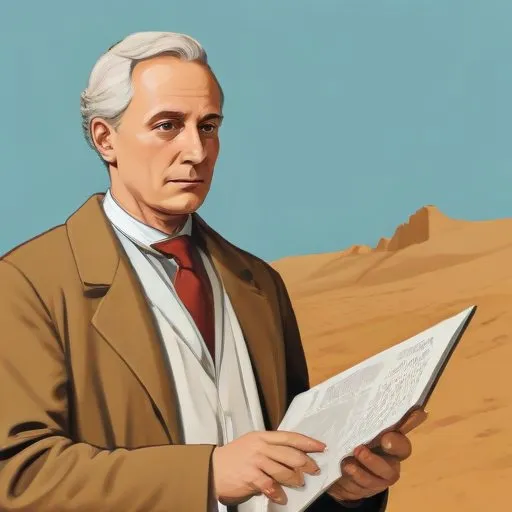
An English archaeologist and physician who pioneered the study of Stonehenge and other ancient British monuments, producing influential but sometimes fanciful theories about their origins.
William Stukeley is renowned for his groundbreaking contributions to the field of archaeology, particularly in the investigation of prehistoric monuments such as Stonehenge and Avebury in Wiltshire. As a pioneering antiquarian, physician, and Anglican clergyman, Stukeley's work laid the foundation for the development of archaeology as a scholarly discipline.
Born on November 7, 1687, in Holbeach, Lincolnshire, Stukeley was the son of a lawyer. He initially worked in his father's law business before attending Saint Benet's College, Cambridge (now Corpus Christi College). In 1709, he began studying medicine at St Thomas Hospital, Southwark, and later worked as a general practitioner in Boston, Lincolnshire.
From 1710 to 1725, Stukeley embarked on annual tours of the countryside, seeking out archaeological monuments and other features that interested him. He meticulously documented his findings, publishing several accounts of his travels. This dedication to recording and understanding the past marked the beginning of his illustrious career as an antiquarian.
In 1717, Stukeley returned to London and established himself within the city's antiquarian circles. His reputation continued to grow, leading to his election as a Fellow of the Royal Society in 1718. That same year, he became the first secretary of the Society of Antiquaries of London, solidifying his position as a leading figure in the field.
In 1721, Stukeley became a Freemason, and in 1722, he co-founded the Society of Roman Knights, an organization devoted to the study of Roman Britain. These affiliations not only expanded his network but also deepened his understanding of the ancient world.
In the early 1720s, Stukeley developed a particular interest in Stonehenge and Avebury, two prehistoric stone circles in Wiltshire. He visited these sites repeatedly, undertaking rigorous fieldwork to determine their dimensions. His research and findings, published in numerous books, provided invaluable insights into these mysterious monuments, establishing him as an authority on the subject.
In 1726, Stukeley relocated to Grantham, Lincolnshire, where he married and continued his antiquarian pursuits. In 1729, he was ordained as a cleric in the Church of England and appointed vicar of All Saints Church in Stamford, Lincolnshire. Through his writings and teachings, Stukeley sought to promote the study of antiquities as a means of combating the growth of deism and freethought in Britain.
William Stukeley's tireless efforts to document and understand Britain's ancient past have left an indelible mark on the field of archaeology. His work inspired generations of scholars, shaping the course of archaeological inquiry and cementing his position as one of the most influential antiquarians in history.
Through his numerous publications, Stukeley not only shared his knowledge with the world but also ensured the preservation of Britain's rich cultural heritage for generations to come.
Born in 1695
A pioneering geologist and archaeologist who explored Cornwall's mining heritage and ancient monuments, shedding light on the region's rich history.
Born in 1551
Renowned for meticulously documenting England's antiquities and historical sites, this 16th-century scholar authored Britannia, a seminal work that shaped the country's understanding of its past.
Born in 1573
Designed iconic English buildings, including the Queen's House, blending Renaissance and classical styles. He's considered the father of English Palladian architecture.
Born in 1656
Predicted celestial events, including the return of a comet that bears his name, and made significant contributions to navigation, astronomy, and mathematics.
Born in 1626
A 17th-century pioneer in antiquarian studies, collecting and preserving historical records, and making significant contributions to the fields of archaeology, architecture, and biography.
Born in 1620
A 17th-century horticulturalist and writer who penned influential books on gardening, forestry, and architecture, shaping the English landscape and aesthetic. His works remain essential reading for garden enthusiasts and historians.
Born in 1640
An English chemist and academic who studied and wrote about alchemy, chemistry, and natural history, making significant contributions to the field of chemistry. He's also known for his work on the first comprehensive catalog of British fossils.
