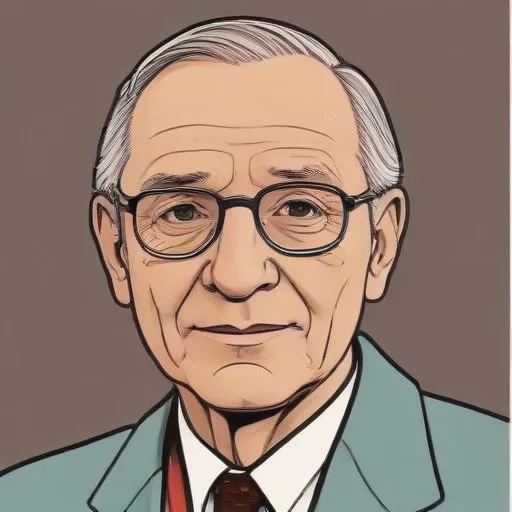
The Quadrupole Maestro: Wolfgang Paul's Legacy in Physics
A Pioneer in Ion Traps and Mass Spectrometry
Wolfgang Paul, a German physicist, revolutionized the field of mass spectrometry by co-developing the non-magnetic quadrupole mass filter, a groundbreaking invention that laid the foundation for what is now known as an ion trap. This pioneering work earned him a share of the Nobel Prize in Physics in 1989, alongside
Hans Georg Dehmelt, with the other half awarded to Norman Foster Ramsey, Jr.
Early Life and Education
Born on August 10, 1913, in Lorenzkirch, Germany, Paul grew up in Munich, where his father, a professor of pharmaceutical chemistry, instilled in him a passion for science. He began his academic journey at the Technical University of Munich, later transferring to Technische Universität Berlin in 1934, where he earned his Diploma in 1937 under the guidance of
Hans Geiger. Paul completed his PhD in 1940 at Technische Universität Berlin, working with Hans Kopfermann.
Academic Career and Research
Paul's academic career spanned several decades, with notable positions at the University of Göttingen, where he worked as a private lecturer with Hans Kopfermann, and later as a professor of Experimental Physics at the University of Bonn, a position he held from 1952 until his passing in 1993. During his tenure, he also served as the director of the Division of Nuclear Physics at CERN from 1965 to 1967. Paul's research focused on isotope separation, mass spectrometry, and the development of techniques for trapping charged particles using electric quadrupole fields.
Scientific Contributions and Innovations
Paul's work on quadrupole mass filters led to the creation of Paul traps, which are extensively used today to contain and study ions. He also developed molecular beam lenses and worked on the construction of electron synchrotrons, including a 500 MeV electron synchrotron and a 2500 MeV one in 1965. Additionally, Paul explored the containment of slow neutrons in magnetic storage rings, measuring the free neutron lifetime.
A Humorous Connection
Paul often humorously referred to
Wolfgang Pauli, another renowned physicist, as his "imaginary part" if their surnames were considered as complex numbers. This whimsical connection highlights the lighthearted side of Paul's personality, often overlooked in discussions of his groundbreaking scientific contributions.
Awards and Honors
Paul's work was recognized with the Nobel Prize in Physics in 1989, a testament to his innovative spirit and contributions to the field of physics.
Legacy and Impact
Wolfgang Paul's work has had a profound impact on modern physics, particularly in the areas of mass spectrometry and ion trapping. His legacy continues to inspire new generations of scientists, ensuring that his innovative spirit and passion for discovery will endure for years to come.
FAQ
What was Wolfgang Pauls contribution to physics?
Wolfgang Paul was a German physicist who made significant contributions to the development of particle accelerators and storage rings. He was awarded the Nobel Prize in Physics in 1989 for his work on the development of the ion trap.
What was Wolfgang Pauls early life like?
Wolfgang Paul was born on August 10, 1913, in Lorenzkirch, Germany. He studied physics at the Technical University of Berlin and later earned his Ph.D. from the University of Göttingen.
What were Wolfgang Pauls notable research projects?
Wolfgang Pauls notable research projects included the development of the electron cyclotron resonance accelerator and the storage ring, which enabled the precise study of subatomic particles. He also worked on the development of the ion trap, which allows for the precise manipulation of charged particles.
What awards and honors did Wolfgang Paul receive?
Wolfgang Paul received numerous awards and honors for his contributions to physics, including the Nobel Prize in Physics, the Max Planck Medal, and the Hughes Medal.
What was Wolfgang Pauls legacy in the field of physics?
Wolfgang Paul left a lasting legacy in the field of physics, known for his groundbreaking work on particle accelerators and storage rings. His contributions have paved the way for significant advances in our understanding of the subatomic world.