


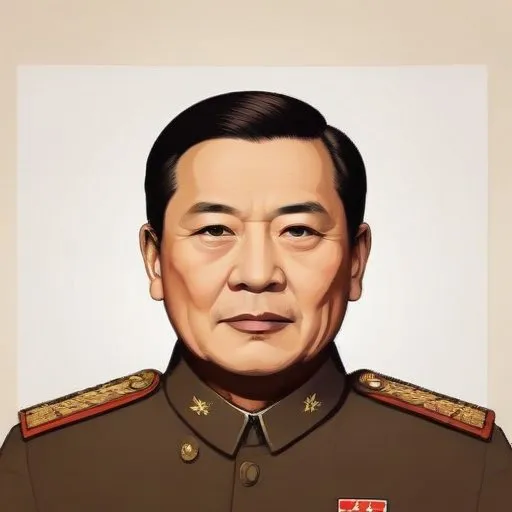
A Chinese military leader and politician who served as the Head of State of the People's Republic of China, playing a crucial role in the country's modernization and reform. He's most known for his efforts in stabilizing the country after Mao's death and introducing economic reforms.
Ye Jianying, one of the most influential figures in modern Chinese history, is revered for his instrumental role in ending the Cultural Revolution and propelling China towards economic reform. As a military leader and politician, he played a crucial part in the 1976 coup that overthrew the Gang of Four, paving the way for Deng Xiaoping's rise to power.
Born on April 28, 1897, in Jiaying county, Guangdong Province, Ye Jianying came from a wealthy Christian Hakka merchant family. His early life was marked by tragedy, with many of his siblings succumbing to severe illness. Despite these challenges, Ye persevered, graduating from the Yunnan Military Academy in 1919. He went on to join the Kuomintang (KMT) and later taught at the Whampoa Military Academy.
In 1927, Ye Jianying made the pivotal decision to join the Communist Party of China (CPC), a move that would shape the course of his life and China's destiny. That same year, he participated in the failed Nanchang Uprising, a rebellion that forced him to flee to Hong Kong with Zhou Enlai and Ye Ting. Despite this setback, Ye remained committed to the communist cause, faithfully carrying out his duties during the Guangzhou Uprising.
After fleeing to Hong Kong, Ye Jianying traveled to Moscow, where he studied military science. Upon his return to China in 1932, he joined the Jiangxi Soviet, serving as Chief of Staff of Zhang Guotao's Fourth Front Army. During the Long March, Ye's military prowess and strategic thinking earned him recognition, and he eventually became a key supporter of Deng Xiaoping.
Ye Jianying's most significant contribution to Chinese history came in 1976, when he masterminded the coup that toppled the Gang of Four, bringing an end to the Cultural Revolution. This bold move paved the way for Deng Xiaoping's rise to power and marked the beginning of China's modernization.
From 1978 to 1983, Ye Jianying served as Chairman of the Standing Committee of the National People's Congress, effectively acting as China's head of state. During this period, he worked closely with Deng Xiaoping to implement economic reforms, solidifying his legacy as a champion of modernization.
Ye Jianying's personal life was marked by simplicity and humility. Despite his immense power and influence, he remained humble and dedicated to the communist cause. His legacy extends beyond his political achievements, inspiring generations of Chinese citizens to strive for a better future.
Ye Jianying's wisdom and leadership are reflected in his quotes, such as:
Ye Jianying's remarkable life and achievements have left an indelible mark on Chinese history, cementing his status as a national hero and a testament to the power of vision, determination, and leadership.
Born in 1904
A Chinese revolutionary and statesman who led the country's economic reforms, transforming it into a global superpower. He's credited with opening up China to the world and introducing capitalist principles.
Born in 1893
Leader of the Chinese Communist Party who implemented radical social and economic reforms, including the Great Leap Forward and the Cultural Revolution, shaping modern China's politics and economy.
Born in 1898
The first Premier of the People's Republic of China, serving from 1949 until his death in 1976, is most known for his key role in the Chinese Communist Party and his diplomatic efforts to improve relations with the West. He played a crucial part in shaping China's foreign policy and economy during a pivotal period in the country's history.
Born in 1898
A prominent military leader who played a crucial role in the Chinese Civil War and later became a key figure in the Communist Party, known for his criticisms of Mao's policies. He was eventually purged and persecuted during the Cultural Revolution.
Born in 1907
A powerful Chinese military leader and politician who rose to prominence during the Chinese Civil War and later became a close ally of Mao Zedong, playing a crucial role in the Cultural Revolution. He is infamous for his alleged plot to overthrow Mao and his mysterious death in a plane crash.
