


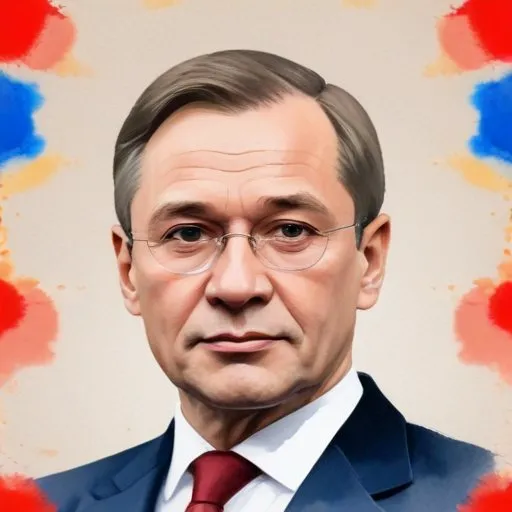
Russian economist and politician who played a key role in shaping the country's post-Soviet economy, introducing radical reforms to transition from a planned to a market economy.
Yegor Gaidar, a Russian economist, politician, and author, is best known for his role as the Acting Prime Minister of Russia from June to December 1992, during which he orchestrated the country's shock therapy reforms. This bold economic experiment aimed to rapidly transition Russia from a planned to a market-based economy, earning Gaidar both praise and criticism.
Born on March 19, 1956, in Moscow, Soviet Union, Gaidar came from a family of writers and intellectuals. His paternal grandfather, Arkady Gaidar, was a renowned Soviet writer, and his maternal grandfather, Pavel Bazhov, was also a writer. Gaidar's father, Timur Gaidar, was a military correspondent and a friend of Raul Castro.
Gaidar's academic background in economics led him to become a researcher at the Soviet Academy of Sciences. He later joined the government, serving as the Deputy Minister of Finance from 1991 to 1992. In June 1992, he became the Acting Prime Minister of Russia, a position he held until December of the same year.
Gaidar's tenure as Acting Prime Minister was marked by the implementation of shock therapy reforms, designed to rapidly liberalize Russia's economy. The reforms aimed to stimulate economic growth, but they also led to widespread poverty, hyperinflation, and social unrest. Many Russians blamed Gaidar for the resulting economic hardships, while liberals praised him for taking bold action to prevent complete economic collapse.
Gaidar was a strong advocate for liberal economic policies and market-oriented reforms. He believed that rapid privatization and deregulation were essential for Russia's economic recovery. His policies were influenced by the ideas of Western economists, particularly those of Jeffrey Sachs, who advised the Russian government during the early 1990s.
Gaidar's policies had a lasting impact on Russia's economic landscape. While they were controversial, they also paved the way for Russia's eventual economic recovery. His reforms influenced economic policy in other post-Soviet states and continue to be debated among economists and policymakers.
Gaidar was a prolific writer and published several books on economics and politics. His most notable works include "Days of Defeat and Victory" and "State and Evolution." He also served as the Director of the Institute for Economy in Transition from 1992 to 2003.
Gaidar's legacy is complex and multifaceted. While many Russians view him as the architect of their economic hardships, others see him as a visionary who took bold action to save the country from collapse. His reforms continue to shape Russia's economy, and his influence can be seen in the country's modern economic landscape.
Gaidar passed away on December 16, 2009, at the age of 53, due to complications from pulmonary edema.
"I am not a politician, I am an economist. I do not care about being popular, I care about being right."
Gaidar's policies and reforms were often compared to those of other prominent economists and policymakers of the time, including Jeffrey Sachs and Anatoly Chubais. While they shared some similarities, Gaidar's approach was distinct in its rapid and radical nature.
Yegor Gaidar's legacy continues to be debated among economists, policymakers, and historians. While his policies were controversial, they undoubtedly shaped the course of Russia's economic history. His story serves as a reminder of the complexities and challenges of economic reform in the post-Soviet era.
95 Years Old
First President of Russia, leading the country's transition from communism to democracy, and known for his bold reforms and iconic leadership style.
74 Years Old
A Russian politician who has dominated the country's politics for over two decades, known for his authoritarian leadership style and controversial foreign policy decisions.
95 Years Old
The last leader of the Soviet Union, who introduced reforms that led to the end of the Cold War and the collapse of communism, earning a Nobel Peace Prize. He's known for his policies of glasnost and perestroika, which transformed the Soviet Union and the world.
88 Years Old
A Russian politician who served as Prime Minister from 1992 to 1998, known for his role in shaping post-Soviet Russia's economy and politics.
