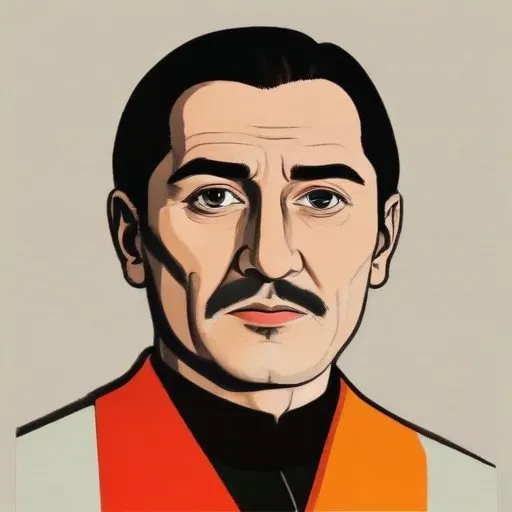
The Revolutionary Theatre Director: Yevgeny Vakhtangov
A Pioneer of Avant-Garde Theatre
Yevgeny Vakhtangov is renowned for his groundbreaking contributions to the world of theatre, leaving an indelible mark on the craft. His distinctive style, which blended the psychological techniques of
Konstantin Stanislavski with the avant-garde experiments of Vsevolod Meyerhold, continues to inspire generations of actors, directors, and theatre practitioners.
Early Life and Education
Born on February 13, 1883, in Vladikavkaz, Terek Oblast (now the capital of Northern Ossetia), Vakhtangov was the son of an Armenian father and a Russian mother. His early education was marked by a brief stint at Moscow State University, which he left to join the Moscow Art Theatre in 1911.
Rise to Prominence
Vakhtangov's talent and dedication soon propelled him up the ranks at the Moscow Art Theatre. By 1920, he was in charge of his own theatre studio, where he began to develop his unique approach to theatre. This studio would later be named the Vakhtangov Theatre in his honor, four years after his untimely death.
A New Era of Theatre
Vakhtangov's productions were a fusion of innovative techniques, incorporating masks, music, dance, abstract costume, and avant-garde sets. He delved deep into the analysis of play texts, uncovering the psychological motivations of characters. This approach not only captivated audiences but also influenced some of the most prominent figures in theatre, including Michael Chekhov, who considered Vakhtangov a mentor and friend.
Influence and Legacy
The Vakhtangov Theatre, now one of the most esteemed institutions in Russia, continues to carry forward his legacy. Vakhtangov's work has inspired theatre practitioners worldwide, including
Lee Strasberg, who praised his use of the Stanislavski System as "even more brilliant and more imaginative" than Stanislavski's own.
Bertolt Brecht, a prominent German theatre practitioner, also acknowledged Vakhtangov's innovative approach as a precursor to his own theatre style.
Major Works
Vakhtangov's most notable production was
Princess Turandot in 1922, a masterpiece that showcased his unique blend of avant-garde and psychological techniques. This production remains a testament to his groundbreaking approach to theatre.
A Lasting Impact
Yevgeny Vakhtangov's contributions to theatre have had a lasting impact on the art form. His legacy extends beyond his own productions, influencing generations of theatre practitioners and continuing to shape the course of modern theatre.
- Vakhtangov's theatre studio, now the Vakhtangov Theatre, remains a leading institution in Russia.
- His approach to theatre continues to inspire actors, directors, and playwrights worldwide.
- He paved the way for avant-garde theatre, influencing the likes of Bertolt Brecht and Lee Strasberg.
Yevgeny Vakhtangov's revolutionary approach to theatre has left an indelible mark on the art form, ensuring his place as one of the most influential theatre directors of the 20th century.
FAQ
What is Yevgeny Vakhtangovs significance in Russian theater?
Yevgeny Vakhtangov was a prominent Russian-Armenian actor and director who made significant contributions to Russian theater, particularly in the development of theatrical realism. His innovative approaches to acting and staging continue to influence Russian theater today.
What was Yevgeny Vakhtangovs style of acting?
Vakhtangovs acting style was characterized by his emphasis on emotional authenticity and psychological depth. He believed in immersing himself in his characters inner lives to create nuanced and compelling performances.
What notable plays did Yevgeny Vakhtangov direct?
Vakhtangov directed several notable plays, including Anton Chekhovs The Seagull and Maurice Maeterlincks Princess Maleine. His productions were known for their innovative use of lighting, set design, and actor movement.
Where did Yevgeny Vakhtangov study acting?
Vakhtangov studied acting at the Moscow Art Theatre under the guidance of Konstantin Stanislavski, a renowned Russian actor and director.
What was Yevgeny Vakhtangovs impact on Soviet theater?
Vakhtangovs work had a profound impact on Soviet theater, influencing a generation of actors and directors. His commitment to realistic and psychologically nuanced performances helped to shape the development of Soviet drama.