


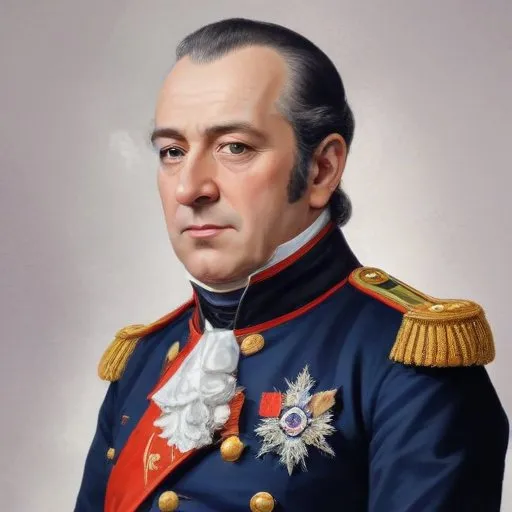
A French general and politician who served as Prime Minister of France, known for his military victories and brief tenure as head of government. He played a key role in shaping France's early 19th-century politics.
Douard Adolphe Casimir Joseph Mortier, also known as Marshal Mortier, is revered as one of France's greatest military leaders and diplomats. He is renowned for his heroic feats during the Napoleonic Wars and his subsequent career as a statesman, earning him the title of Marshal of France.
Born on February 13, 1768, in Le Cateau-Cambrésis, France, Mortier's life was marked by an unwavering commitment to his country. He embarked on a military career at the tender age of 17, quickly rising through the ranks due to his exceptional bravery and tactical prowess.
Mortier's military prowess earned him recognition during the French Revolutionary Wars, where he played a crucial role in several battles, including the Battle of Hondschoote and the Siege of Mainz. His valor and strategic brilliance caught the attention of Napoleon Bonaparte, who appointed him as one of his trusted generals.
During the Napoleonic Wars, Mortier demonstrated his exceptional leadership skills, leading troops to victory in numerous battles, including the Battle of Dürenstein and the Battle of Ostrach. His accomplishments earned him the esteemed title of Marshal of France, a distinction reserved for the highest-ranking military officers.
Following Napoleon's defeat, Mortier's diplomatic skills came to the forefront. He played a crucial role in negotiating the Treaty of Fontainebleau, which led to Napoleon's abdication. Mortier's diplomatic finesse earned him the trust of the provisional government, who appointed him as Minister of War.
During the Bourbon Restoration, Mortier served as Minister of State and played a key role in shaping France's foreign policy. He was instrumental in negotiating the Treaty of Paris, which led to the withdrawal of foreign troops from France and marked the beginning of a new era of peace.
Mortier's remarkable career was marked by numerous honors and accolades. He was awarded the Grand Eagle of the Legion of Honor, France's highest military distinction, and was named a Peer of France.
His legacy extends beyond his military and diplomatic achievements. Mortier was a devoted husband and father, and his personal relationships were marked by warmth and kindness. He was known for his humility and kindness, earning the respect and admiration of his contemporaries.
"A good general is not one who is afraid to take risks, but one who knows how to calculate them." - Marshal Mortier
Mortier's life and career were shaped by the tumultuous era in which he lived. His experiences during the French Revolution and the Napoleonic Wars had a profound impact on his worldview and shaped his approach to diplomacy and statesmanship.
Today, Mortier's legacy serves as a testament to the power of bravery, statesmanship, and diplomacy. His remarkable life continues to inspire generations, reminding us of the importance of leadership, courage, and the pursuit of peace.
Born in 1769
A French military leader who rose to prominence during the French Revolution and became Emperor of France, known for his military conquests and reorganization of Europe. He is also famous for his Napoleonic Code, which remains a foundation of modern law.
Born in 1767
Radical Jacobin leader during the French Revolution, known for his extreme views and role in the Reign of Terror.
Born in 1755
A key figure in the French Revolution, leading the coup that overthrew Maximilien Robespierre and later serving as a key advisor to Napoleon Bonaparte. He played a crucial role in shaping French politics during a tumultuous period.
Born in 1753
A French general, mathematician, and politician who played a crucial role in the French Revolution and is considered the "Organizer of Victory" for his military strategies, and also made significant contributions to mathematics and engineering.
Born in 1759
A leading figure of the French Revolution, instrumental in the overthrow of the monarchy and establishment of the First French Republic, known for his radical Jacobin ideology.
Born in 1758
Radical leader of the French Revolution, instrumental in the Reign of Terror, and advocate for the execution of King Louis XVI.
Born in 1743
A radical Jacobin leader who advocated for the execution of King Louis XVI and was a key figure in the Reign of Terror during the French Revolution, known for his extreme views and assassination in his bathtub.
Born in 1760
French journalist and politician who sparked the French Revolution with his impassioned speeches and writings, advocating for democracy and social reform.
