


In a surprising turn of events, a premature bomb explosion on October 9, 1911, set off a chain reaction that would change the course of Chinese history. The very next day, the Wuchang Uprising began, marking the start of a rebellion that would ultimately topple the centuries-old Qing dynasty and pave the way for the Republic of China.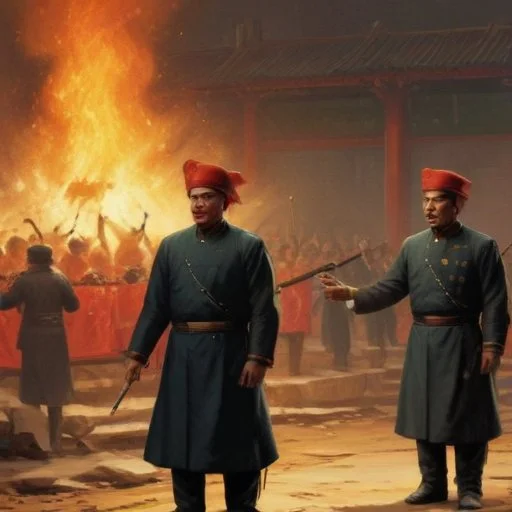
The Qing dynasty, which had ruled China since 1644, was showing signs of weakness and decay. Corruption was rampant, and the government was struggling to maintain control over a rapidly changing society. The dynasty's inability to adapt to the demands of modernization created an environment ripe for revolution.
At the forefront of the Wuchang Uprising were two key figures: Huang Xing and Song Jiaoren. Huang, a member of the Chinese Revolutionary Alliance, played a crucial role in planning and executing the uprising. Song, a charismatic leader and skilled strategist, would later become a prominent figure in the newly formed provisional government.
The Wuchang Uprising marked the beginning of the end for the Qing dynasty. The provisional government, formed in the aftermath of the uprising, would go on to establish the Republic of China, ending centuries of imperial rule. This momentous event paved the way for modernization, reform, and a new era of Chinese politics.
The Wuchang Uprising had far-reaching cultural and social implications. The fall of the Qing dynasty marked a shift away from traditional Confucian values and towards a more modern, Westernized approach to governance and society. This cultural shift would have a profound impact on Chinese identity and society in the decades to come.
In his memoirs, Huang Xing would later recall the sense of excitement and urgency that gripped the rebels as they prepared to launch the uprising. "We knew that our action would either bring us glory or condemnation," he wrote. "But we were determined to take the risk, for we believed that our country deserved a better future."
The Wuchang Uprising's legacy extends far beyond the fall of the Qing dynasty. The Republic of China, established in its aftermath, would go on to play a significant role in Chinese politics and history. The uprising also inspired a generation of Chinese revolutionaries, including Mao Zedong, who would later lead the Communist Party to power.
Huang Xing, a key figure behind the Wuchang Uprising, was born in 1874 in Changsha, Hunan Province. He was a member of the Chinese Revolutionary Alliance, a group dedicated to overthrowing the Qing dynasty and establishing a republican government.
Huang's leadership skills and strategic thinking played a crucial role in the planning and execution of the uprising. His bravery and conviction inspired others to join the cause, and his tactical decisions helped to ensure the success of the rebellion.
Despite his significant contributions to the revolution, Huang remained humble and dedicated to the cause. He continued to serve the new government, helping to establish the Republic of China and pave the way for modernization and reform.

The Wuchang Uprising did not occur in a vacuum. It was part of a larger pattern of revolutionary movements sweeping across Asia and Europe in the early 20th century.
The Qing dynasty's weakness created an opportunity for foreign powers to exert their influence over China. Japan, in particular, had been expanding its empire and saw the Wuchang Uprising as a chance to gain a foothold in China.
The uprising also had implications for the global balance of power. The fall of the Qing dynasty marked the end of a centuries-old imperial system and paved the way for a new era of republican governments in Asia.
The Wuchang Uprising marked a significant shift in Chinese culture, as traditional Confucian values gave way to modern, Westernized ideas.
The uprising inspired a new generation of Chinese intellectuals, who saw the revolution as an opportunity to create a more modern and equitable society.
The fall of the Qing dynasty also led to a reevaluation of Chinese identity, as the country began to look outward to the rest of the world for inspiration and guidance.

The Wuchang Uprising had significant political implications, both within China and around the world.
The establishment of the Republic of China marked the first time a republican government had been established in Asia, inspiring similar movements across the continent.
The uprising also led to a reevaluation of China's relationship with the rest of the world, as the new government sought to establish diplomatic relations with foreign powers and assert its sovereignty.
The Hunan Army, a regional military force, played a crucial role in the Wuchang Uprising.
The Hunan Army's involvement in the uprising is documented in a series of letters and telegrams exchanged between army leaders and government officials.
One such letter, written by General Li Yuanhong, reveals the army's plan to seize key government buildings and military installations.