


The Supreme Army Command of Germany, the highest military authority in the country, made a shocking decision on September 29, 1918, that would change the course of history. They told Kaiser Wilhelm II and Imperial Chancellor Georg Michaelis that it was time to negotiate an armistice, effectively admitting defeat in World War I.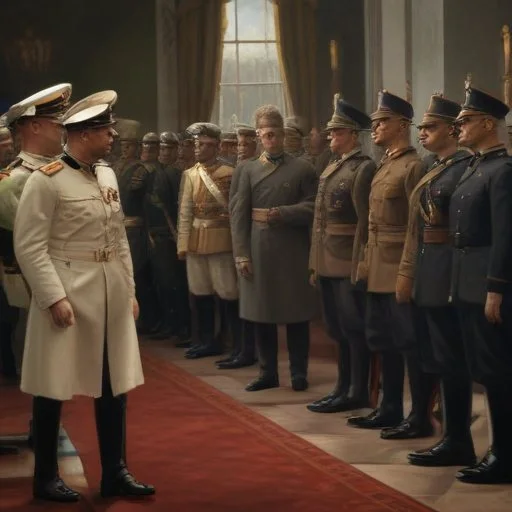
The German military, once considered invincible, had been struggling to maintain its momentum on the battlefield. The Allies, led by the United States, France, and Britain, had been gaining ground, and the German army was weakening. The Supreme Army Command, led by General Erich Ludendorff, had been advising the Kaiser to seek a peace settlement, but Wilhelm II had been reluctant to accept defeat.
 General Erich Ludendorff, the chief of the German General Staff
Kaiser Wilhelm II, the German emperor, was taken aback by the Supreme Army Command's decision. He had always believed in the superiority of the German military and had been convinced that they could still win the war. The news of defeat was a bitter pill to swallow, and Wilhelm II struggled to come to terms with the fact that his military might was on the brink of collapse.
The Supreme Army Command's decision marked the beginning of a new era in German politics. The Kaiser, realizing that the war was lost, began to consider alternatives. On October 3, 1918, Germany sent a note to the United States, requesting an armistice based on the Fourteen Points outlined by President Woodrow Wilson. The Allies, however, were skeptical of Germany's intentions and demanded unconditional surrender.
According to historian John Keegan, General Ludendorff was "haunted by the specter of defeat" and became increasingly erratic in the final months of the war. Wilhelm II, on the other hand, was reportedly "broken" by the news of defeat and became reclusive, refusing to appear in public.
The German surrender in World War I set a precedent for future conflicts. The Allies' demand for unconditional surrender led to a shift in the way wars were fought and negotiations were conducted. The Treaty of Versailles, although flawed, established the principle of collective security and paved the way for the creation of the League of Nations.
The Supreme Army Command's decision to seek an armistice marked a turning point in World War I, bringing an end to one of the deadliest conflicts in human history. As we reflect on this pivotal moment, we are reminded of the devastating consequences of war and the importance of seeking peace through diplomacy and negotiation.
General Erich Ludendorff was a German general and quartermaster-general of the German army during World War I. He was a key figure in the German war effort and played a crucial role in the Supreme Army Command's decision to seek an armistice. Ludendorff was known for his tactical brilliance and his ability to adapt to changing circumstances on the battlefield.
Despite his military prowess, Ludendorff was also known for his ruthless tactics and his willingness to take extreme measures to achieve his goals. He was a strong supporter of the German war effort and believed that the war could still be won, even in the face of mounting losses and setbacks.
Ludendorff's legacy is still debated among historians today, with some viewing him as a brilliant military strategist and others seeing him as a ruthless and cynical leader.
Historians have long debated the reasons behind Germany's defeat in World War I. Some have argued that the German war effort was doomed from the start, citing the country's inferior economy and industrial base compared to the Allies.
Others have pointed to the role of the German military leadership, including General Ludendorff, in making strategic blunders and miscalculations that ultimately led to defeat.
According to historian Niall Ferguson, the German defeat can be attributed to a combination of factors, including the failure of the German army to adapt to new technologies and tactics, as well as the weakness of the German economy.The surrender of Germany in 1918 had a profound impact on German culture and society. The defeat marked a turning point in German history, leading to a period of soul-searching and introspection about the country's values and identity.
The war's aftermath saw a flourishing of artistic and cultural expression, as Germans sought to come to terms with the devastation and loss of the war.
The Treaty of Versailles, imposed on Germany by the Allies, led to widespread resentment and anger among Germans, who felt that their country had been unfairly punished and humiliated.
The defeat of Germany in World War I led to a political crisis in the country, as the Kaiser and his government faced widespread criticism and opposition.
The abdication of Kaiser Wilhelm II and the establishment of the Weimar Republic marked a significant shift in the German political landscape, as the country transitioned from a monarchy to a democracy.
The Weimar Republic, however, was beset by political instability and economic crisis, creating an environment in which extremist groups like the Nazi Party could thrive.
The rise of the Nazi Party, and ultimately Adolf Hitler, was a direct consequence of the political vacuum created by the German defeat in World War I.The German defeat in World War I took place against the backdrop of a rapidly changing global landscape. The war marked the end of the old European order and the rise of new global powers, including the United States and the Soviet Union.
The Treaty of Versailles, imposed on Germany by the Allies, reflected the shifting balance of power in Europe, as the old imperial powers sought to maintain their dominance.
The German defeat also marked a turning point in the relationship between Europe and the United States, as the latter emerged as a major world power and began to take a more active role in global affairs.