


The gears of humanity's darkest machinery were set in motion on this fateful day, marking the beginning of the most heinous crime against humanity in recorded history – the Holocaust. The first prisoners, comprising 783 Polish individuals, mostly intellectuals, artists, and members of the resistance, stepped into the unknown, unaware of the unimaginable horrors that awaited them at Auschwitz, the notorious concentration camp.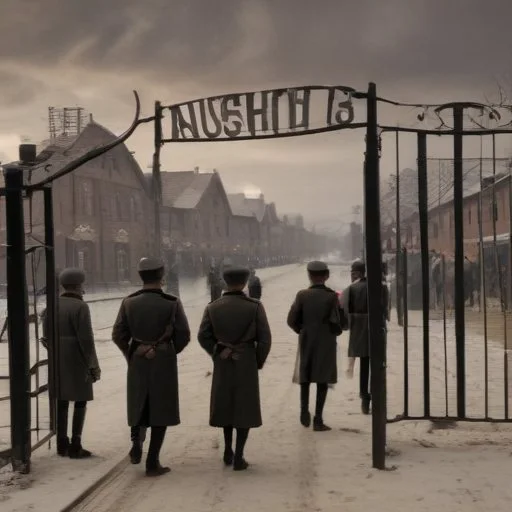
The seeds of hatred and intolerance were sown long before the first prisoners arrived at Auschwitz. The years preceding World War II saw a surge in anti-Semitic sentiment across Europe, fueled by racial and religious prejudices. The Nazi Party, with Adolf Hitler at its helm, capitalized on these sentiments, spreading propaganda that scapegoated Jews for Germany's economic woes.
As the prisoners disembarked at Auschwitz, they were greeted by the chilling presence of Rudolf Höss, the commandant who would oversee the camp's brutal regime. The seemingly efficient and organized system, designed to dehumanize and eventually exterminate, was set in motion. The prisoners were subjected to inhumane living conditions, forced labor, and eventually, the gas chambers, where millions would meet their fate.
Rudolf Höss, the commandant of Auschwitz, and Adolf Eichmann, the SS officer responsible for implementing the "Final Solution," were instrumental in orchestrating the Holocaust. Their crimes against humanity would eventually be brought to light, but the damage had already been done.
The Holocaust, a stark reminder of humanity's capacity for evil, has left an indelible mark on world history. The Auschwitz-Birkenau Memorial and Museum, established on the site of the former concentration camp, serves as a poignant testament to the victims and a warning to future generations.
"The world is a dangerous place, not because of those who do evil, but because of those who look on and do nothing." – Albert Einstein
In the face of unimaginable horror, the world was largely silent, allowing the atrocities to unfold. The lessons of the Holocaust serve as a stark reminder of the importance of standing against injustice and promoting tolerance, compassion, and humanity.
The concept of Auschwitz as a concentration camp dates back to 1939, when Heinrich Himmler, the head of the SS, approved the construction of a new camp in the Polish town of Oświęcim. The location was strategic, with good rail connections to major cities in Europe. Initially, the camp was intended to hold Polish prisoners, but it quickly expanded to include Jews, Romani people, homosexuals, and others deemed undesirable by the Nazi regime.
The camp's design was influenced by the earlier concentration camps, such as Dachau and Sachsenhausen. However, Auschwitz was unique in its scale and brutality, with a network of subcamps and satellite camps that sprawled across southern Poland.
The first commandant of Auschwitz was Rudolf Höss, a seasoned SS officer who would later become notorious for his role in the Holocaust.
Rudolf Höss, the commandant of Auschwitz, was a complex figure, driven by a combination of ideology, ambition, and a desire for power. Born in 1900, Höss was a farmer's son who grew up in a devout Catholic family. He joined the Nazi Party in the early 1930s and quickly rose through the ranks, becoming a key figure in the SS.
Höss was a meticulous and efficient administrator, who oversaw the day-to-day operations of Auschwitz with ruthless precision. He was also a skilled manipulator, who used his charm and charisma to deceive and exploit his prisoners.
Höss's own words, recorded in his memoirs, provide a chilling insight into his mindset: "I was always humane and decent, but I was forced to suppress these qualities in order to fulfilled my duty."The Holocaust was a pan-European phenomenon, facilitated by the Nazi occupation of much of Europe during World War II. The conquest of Poland in 1939 marked the beginning of a brutal campaign of territorial expansion, which created a vast network of concentration camps, ghettos, and killing centers.
The Allies' failure to intervene, combined with the Nazi regime's ruthless efficiency, created a climate of impunity that allowed the Holocaust to unfold. The Molotov-Ribbentrop Pact, a non-aggression treaty between Germany and the Soviet Union, further enabled the Nazis to pursue their genocidal policies.
The geographical scope of the Holocaust is a stark reminder of the dangers of unchecked nationalism and militarism.
The Holocaust has had a profound impact on Western culture, shaping our understanding of humanity, morality, and the dangers of unchecked power. The event has inspired countless works of literature, art, music, and film, from Primo Levi's If This Is a Man to Claude Lanzmann's Shoah.
The Holocaust has also influenced countless individuals, from survivors like Elie Wiesel to scholars like Raul Hilberg, who have dedicated their lives to studying and commemorating the event.
The Holocaust has become a universal symbol of human suffering, a powerful reminder of the importance of tolerance, compassion, and human rights.The liberation of Auschwitz in 1945 marked a turning point in modern history, as the full extent of the Nazi regime's atrocities became public. The Nuremberg Trials, held in 1945-1946, aimed to hold accountable those responsible for the Holocaust.
The Holocaust also played a significant role in the establishment of the State of Israel in 1948, as the international community recognized the need for a safe haven for Jewish refugees.
The Holocaust has continued to shape political discourse, influencing debates on human rights, genocide, and international law.