


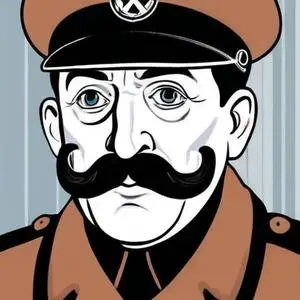
Commandant of Auschwitz concentration camp during WWII, responsible for the murder of over a million people, particularly Jews, during the Holocaust.
Rudolf Hss, a German SS officer, is notorious for serving as the commandant of the Auschwitz concentration camp during World War II. His tenure at Auschwitz spanned from 1940 to 1943 and again from 1944 to 1945, during which he oversaw the implementation of the "Final Solution," resulting in the systematic extermination of millions of Jews and other prisoners.
Born on November 25, 1901, in Baden-Baden, Germany, Hss grew up in a strict Catholic family. His father, Franz Xaver Hss, a former army officer, instilled in him a strong sense of duty and military discipline. Hss claimed to have been briefly abducted by Romani people in his youth, an event that likely shaped his worldview.
During his tenure at Auschwitz, Hss was instrumental in introducing Zyklon B, a pesticide, to facilitate the mass murder of prisoners in gas chambers. This led to the deaths of over a million people, predominantly Jews, as part of the "Final Solution."
After the defeat of Nazi Germany, Hss was captured and put on trial in Poland. He was convicted of war crimes and sentenced to death. On April 16, 1947, Hss was hanged in the courtyard of the Auschwitz camp.
Rudolf Hss's brutal reign at Auschwitz serves as a stark reminder of the atrocities committed during World War II. His actions and ideologies have been widely condemned, and his name has become synonymous with the horrors of the Holocaust.
During his imprisonment, Hss wrote his memoirs, which were later published as "Commandant of Auschwitz: The Autobiography of Rudolf Hoess." The book has sparked controversy, with some criticizing its publication as an attempt to justify or rationalize his heinous crimes.
Rudolf Hss's dark legacy serves as a warning against the dangers of extremism, hatred, and discrimination. His story is a poignant reminder of the importance of promoting tolerance, understanding, and human rights.
Born in 1900
Leading the SS and Gestapo, he oversaw the Nazi regime's brutal security apparatus and implemented the "Final Solution," orchestrating the genocide of six million Jews during World War II.
Born in 1906
A high-ranking Nazi officer responsible for organizing the logistics of the Holocaust, overseeing the mass deportation of Jews to concentration camps during World War II.
Born in 1911
A notorious physician and captain who conducted inhumane experiments on prisoners, particularly twins, during the Holocaust, earning the nickname "Angel of Death".
Born in 1904
A high-ranking Nazi officer and physician who oversaw the Nazi euthanasia program, responsible for the deaths of thousands of people with mental and physical disabilities.
Born in 1892
A ruthless and efficient administrator who oversaw the creation and operation of Nazi concentration camps during World War II, responsible for the deaths of millions of people.
Born in 1903
Austrian-German lawyer and general who served as the highest-ranking leader of the Nazi police forces, responsible for overseeing the Gestapo, SS, and concentration camps during World War II. He was a key figure in the Holocaust and other atrocities committed by the Nazi regime.
Born in 1893
A high-ranking Nazi official, he was a decorated World War I fighter pilot and later became a prominent politician, serving as Minister President of Prussia. He's infamous for his role in the Nazi regime and war crimes trials.
Born in 1893
A German diplomat who served as the Nazi regime's Foreign Minister, orchestrating key alliances and treaties that led to World War II. He was a close associate of Adolf Hitler and played a crucial role in shaping Nazi foreign policy.
