


Karl Marx and Friedrich Engels' iconic publication, The Communist Manifesto, sent shockwaves throughout Europe in 1848, cementing its place as one of the most influential documents in modern history. This incendiary pamphlet boldly predicted the inevitability of a proletarian revolution, where the working class would rise up against the capitalist elite, ultimately leading to a classless society.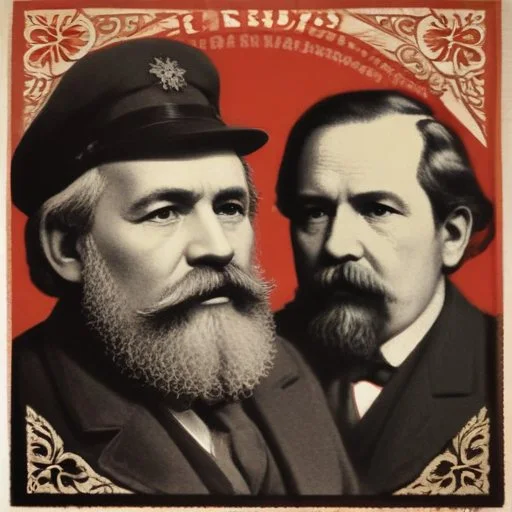
In the mid-19th century, Europe was in the midst of rapid industrialization, which had created a vast chasm between the wealthy bourgeoisie and the exploited proletariat. The air was electric with discontent, as workers began to organize and demand better working conditions, higher wages, and greater social justice. It was against this backdrop of fermenting unrest that Marx and Engels penned their revolutionary manifesto.
Karl Marx, a young German philosopher and economist, had already made a name for himself with his scathing critiques of capitalism. Friedrich Engels, a wealthy industrialist's son, had been swayed by Marx's ideas and agreed to collaborate on a document that would distill the essence of their radical thought.
The Communist Manifesto sparked a maelstrom of debate, inspiring fervent passion and vitriolic criticism in equal measure. As news of the pamphlet spread, it galvanized socialist and communist movements across Europe, influencing the likes of Vladimir Lenin, Mao Zedong, and Fidel Castro.
The manifesto's provocative language and compelling ideology resonated with the disenchanted masses, who saw in it a beacon of hope for a more equitable society. As workers began to organize and demand better working conditions, the manifesto became a battle cry for social and economic change.
The Communist Manifesto was not without its critics, who accused Marx and Engels of promoting violent revolution and undermine the very fabric of society. As the pamphlet's popularity grew, so too did the vitriol aimed at its authors, who were branded as radical extremists.
"The proletariat will use its political supremacy to wrest, by degrees, all capital from the bourgeoisie, to centralize all instruments of production in the hands of the state." - The Communist Manifesto
The Communist Manifesto drew inspiration from earlier works, such as the Declaration of the Rights of Man and of the Citizen, but its unique blend of philosophical rigor and populist appeal set it apart as a seminal work of modern radical thought.
Engels would later recall the electrifying atmosphere of the manuscript's completion, stating, "We were both so excited that we decided to celebrate the event by going out to the nearby woods and chopping down a few trees."
The Communist Manifesto's influence can be seen in the Russian Revolution, the rise of communist China, and the global socialist movement. As a testament to its enduring legacy, the manifesto remains a powerful symbol of resistance against inequality and oppression.
In 2005, the Communist Manifesto was included in the United Nations Educational, Scientific and Cultural Organization's (UNESCO) Memory of the World Register, recognizing its significance as a cultural and intellectual milestone.
The Communist Manifesto has been the subject of intense academic scrutiny, inspiring generations of scholars to engage with its complex ideas and challenging assumptions. As a foundational text of modern sociology and economics, it continues to shape the intellectual landscape.
The Communist Manifesto has been translated into over 200 languages, making it one of the most translated documents in history.
For millions of people around the world, the Communist Manifesto represents a promise of a better tomorrow, where social and economic equality are not just ideals, but a lived reality.
In conclusion, The Communist Manifesto stands as a testament to the power of radical thought, inspiring generations to question the status quo and strive for a more just and equitable society.
Friedrich Engels, the son of a wealthy German textile manufacturer, was a key collaborator in the development of the Communist Manifesto. Born in 1820, Engels was exposed to the harsh realities of industrialization from a young age, which influenced his views on social and economic reform. Despite his privileged upbringing, Engels was drawn to radical thought and became a strong advocate for the working class.
Engels' relationship with Marx was crucial in shaping the manifesto's ideology. He provided valuable insights into the English working-class movement, which helped inform the document's emphasis on proletarian revolution.
After Marx's death, Engels continued to promote their shared vision, editing and publishing several of Marx's works, including the second and third volumes of Das Kapital.

The tumultuous years leading up to 1848 saw widespread unrest across Europe, as workers and peasants took to the streets to demand better living conditions and greater social justice. The failed Revolutions of 1848, which swept across the continent, marked a significant turning point in the development of radical thought.
The French Revolution of 1848, in particular, had a profound impact on Marx and Engels, who saw it as an opportunity to spread their message of proletarian revolution. The revolution's failure, however, led to a period of repression and forced many radicals, including Marx, into exile.
Against this backdrop of social and political upheaval, the Communist Manifesto's call to action resonated with disenchanted workers and intellectuals, who saw it as a beacon of hope for a more equitable society.
The Communist Manifesto's emphasis on class struggle and the role of the proletariat in revolutionary change drew heavily from earlier works, including the Declaration of the Rights of Man and of the Citizen. While these documents inspired the manifesto's ideology, Marx and Engels' work was distinct in its focus on the economic and social conditions of the working class.
In contrast to utopian socialists, such as Charles Fourier and Robert Owen, who advocated for gradual, peaceful reform, Marx and Engels argued that revolution was the only means to achieve true social and economic change.
The manifesto's unique blend of philosophical rigor and populist appeal set it apart from other radical texts of the time, cementing its position as a foundational work of modern socialism.

The Communist Manifesto's impact on cultural and artistic movements has been profound, inspiring generations of artists, writers, and intellectuals to engage with its radical ideology.
From the avant-garde movements of the early 20th century, such as Dadaism and Futurism, to the socially conscious art of the 1960s and 1970s, the manifesto's influence can be seen in the work of artists, including Diego Rivera, Frida Kahlo, and Jean-Luc Godard.
The manifesto's emphasis on the role of the artist as a force for social change has also inspired a range of cultural movements, from the Situationist International to punk rock and hip-hop.
The Communist Manifesto's philosophical and ideological impact has been far-reaching, influencing a range of thinkers and activists across the political spectrum.
From anarchists like Mikhail Bakunin to social democrats like Eduard Bernstein, the manifesto's ideas have been debated, critiqued, and adapted by a diverse range of radical thinkers.Marx and Engels' concept of alienation, which argued that capitalism strips workers of their humanity, has also influenced a range of fields, including sociology, psychology, and literary theory.