


On a fateful day in 1603, Tokugawa Ieyasu, a revered Japanese warlord, stood before Emperor Go-Yōzei to receive the prestigious title of shōgun, effectively solidifying his position as the supreme ruler of Japan. This pivotal moment marked the inception of the Tokugawa shogunate, a dynasty that would dominate the Japanese landscape for the next 250 years.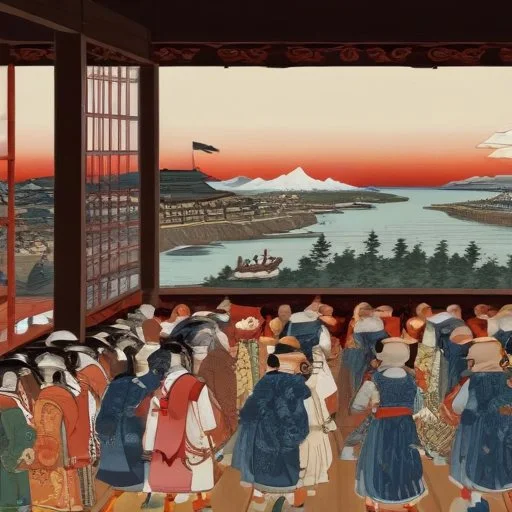
Tokugawa Ieyasu's rise to power was no accident. His impressive military record, coupled with his cunning strategic mind, had earned him the respect of the imperial court. Born in 1543, Ieyasu was a skilled warrior who had fought alongside prominent daimyōs (feudal lords) of the time, including Oda Nobunaga and Toyotomi Hideyoshi. His unwavering loyalty and military prowess eventually led to his appointment as the commander of the Eastern Army during the Battle of Sekigahara in 1600.
Following his victory at Sekigahara, Ieyasu was granted the title of shōgun by Emperor Go-Yōzei, marking the beginning of the Tokugawa shogunate. He established his capital in Edo (modern-day Tokyo), which would become the epicenter of Japanese politics and culture for centuries to come.
The Tokugawa shogunate would go on to shape Japanese history, imposing a period of relative peace and stability known as the Edo period. During this time, the country experienced significant cultural, economic, and social growth. The shogunate also implemented a rigid class system, known as the Four Occupations, which would define Japanese society for centuries to come.
The Tokugawa shogunate had a profound impact on Japanese culture and society. The period saw the rise of ukiyo-e (woodblock prints), haiku poetry, and kabuki theater. The shogunate also promoted Confucianism, which emphasized social hierarchy and loyalty to the state.
In conclusion, the granting of the title of shōgun to Tokugawa Ieyasu marked the dawn of a new era in Japanese history. The establishment of the Tokugawa shogunate would go on to shape the country's destiny for centuries to come, leaving a lasting legacy that continues to influence Japanese society and culture to this day.
Born in 1543, Tokugawa Ieyasu was the son of Matsudaira Hirotada, a minor daimyō in the Mikawa province. Ieyasu's early life was marked by turmoil, with his family frequently changing allegiances and territories. Despite these challenges, he demonstrated exceptional martial prowess and strategic acumen from a young age.
Ieyasu's military education began under the tutelage of the powerful daimyō, Imagawa Yoshimoto. After Yoshimoto's death, Ieyasu allied himself with Oda Nobunaga, a prominent daimyō who would become a pivotal figure in Japanese history. This alliance provided Ieyasu with valuable experience and exposure to the machinations of Japanese politics.
Ieyasu's rise to prominence was further facilitated by his marriage to Lady Tsukiyama, a member of the powerful Takeda clan. This union not only strengthened his alliances but also introduced him to the intricacies of Japanese court politics.

The Battle of Sekigahara, fought on October 21, 1600, was a pivotal conflict that cemented Tokugawa Ieyasu's position as a dominant force in Japanese politics. The battle pitted the Eastern Army, led by Ieyasu, against the Western Army, comprising forces loyal to Toyotomi Hideyoshi.
The battle was marked by intrigue and deception, with Ieyasu employing cunning tactics to outmaneuver his opponents. Despite being outnumbered, the Eastern Army emerged victorious, securing a decisive victory that would shape the course of Japanese history.
The consequences of Sekigahara were far-reaching, with Ieyasu's victory paving the way for his appointment as shōgun and the establishment of the Tokugawa shogunate.
The Tokugawa shogunate's ascension to power marked the beginning of a cultural renaissance in Japan. During the Edo period, the country experienced a flowering of artistic and cultural expression, with the emergence of ukiyo-e woodblock prints, haiku poetry, and kabuki theater.
These art forms not only reflected the social and cultural values of the time but also played a significant role in shaping the Japanese identity. The Edo period's cultural vibrancy was further fostered by the growth of urban centers, particularly Edo, which became a hub of artistic and intellectual activity.
The cultural achievements of the Edo period continue to influence Japanese art, literature, and performance to this day, providing a lasting testament to the Tokugawa shogunate's enduring legacy.

Tokugawa Ieyasu's ascension to power was not solely due to his military prowess; it was also a testament to his exceptional political acumen. Ieyasu possessed a deep understanding of the intricacies of Japanese politics and was adept at forging strategic alliances and manipulating the complex web of relationships between daimyōs.
Ieyasu's mastery of statecraft was evident in his ability to balance the competing interests of various factions and maintain stability during a period of great turmoil. His political genius was further demonstrated by his ability to create a stable and efficient administrative system, which ensured the longevity of the Tokugawa shogunate.
In the early 17th century, Japan was a country in flux, with the decline of the Muromachi shogunate creating a power vacuum that various daimyōs sought to fill. The country was characterized by a complex web of alliances and rivalries, with powerful daimyōs vying for control.
This tumultuous environment provided the backdrop for Tokugawa Ieyasu's rise to power. Ieyasu navigated the treacherous landscape of Japanese politics with ease, forming strategic alliances and exploiting the weaknesses of his rivals to eventually secure the title of shōgun.
The Tokugawa shogunate's establishment marked a significant shift in Japan's geopolitical landscape, with the country entering a period of relative stability and isolationism that would last for over two centuries.