


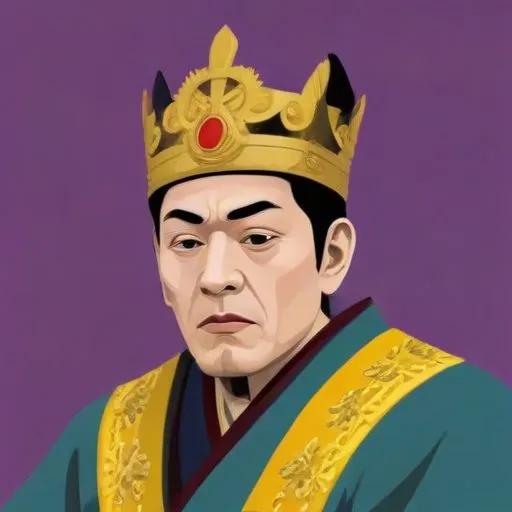
The 107th emperor of Japan, ruling from 1586 to 1603, known for his role in the transition from the Sengoku period to the Edo period, and for being the last emperor to hold significant power. He played a key role in the unification of Japan under the Tokugawa shogunate.
Emperor Go-Yzei, also known as Go-Yzeitenn, was the 107th Emperor of Japan, reigning from 1586 to 1611, a pivotal period that marked the transition from the Azuchi-Momoyama period to the Edo period. This 16th-century sovereign is remembered for his significant role in stabilizing the country during a time of great turmoil and laying the groundwork for the Tokugawa shogunate.
Emperor Go-Yzei was born on December 31, 1571, as Katahito or Kazuhito, the eldest son of Prince Masahito (also known as Prince Sanehito) and a lady-in-waiting. His father was the eldest son of Emperor Ogimachi, making him a direct descendant of the imperial family.
In 1586, at the age of 15, Emperor Go-Yzei ascended to the Chrysanthemum Throne, assuming the role of the 107th Emperor of Japan. His reign would span over 25 years, during which he would work tirelessly to consolidate power and bring stability to the war-torn country.
The Emperor's Imperial family lived with him in the Dairi of the Heian Palace, where he fathered at least 35 children with various consorts and ladies-in-waiting. Notable among his children are:
Emperor Go-Yzei's reign was marked by significant events, including the Battle of Sekigahara in 1600, which led to the establishment of the Tokugawa shogunate. He also played a key role in the construction of the Fushimi Castle, which would become the residence of the Tokugawa shoguns.
The Emperor's legacy is complex, with some historians viewing him as a passive ruler who allowed the Tokugawa regime to consolidate power, while others see him as a shrewd politician who navigated the treacherous waters of samurai politics to ensure the survival of the imperial family.
In 1611, Emperor Go-Yzei abdicated the throne in favor of his son, Emperor Go-Mizunoo, and took the title of Joko, or retired emperor. He spent the remainder of his life in quiet contemplation, passing away on September 25, 1617, at the age of 45.
Emperor Go-Yzei's reign marked a significant turning point in Japanese history, as the country transitioned from the medieval period to the Edo period. His legacy continues to be felt to this day, with the Tokugawa shogunate's influence still visible in modern Japanese politics and society.
Despite his complex legacy, Emperor Go-Yzei remains an important figure in Japanese history, a symbol of the country's resilience and adaptability in the face of turmoil and change.
Born in 1543
Unified Japan's warring states, establishing a dynasty that ruled for over 250 years, and is revered as a brilliant military strategist and statesman.
Born in 1593
Leader of the Toyotomi clan, son of Hideyoshi, and defender of Osaka Castle, known for his bravery and strategic battles against the Tokugawa shogunate.
Born in 1579
The second shogun of the Tokugawa dynasty, who solidified the family's rule and established a rigid feudal system in Japan, known for his military campaigns and administrative reforms.
Born in 1604
The shogun who ruled Japan from 1623 to 1651, known for isolating Japan from the rest of the world and establishing a rigid feudal system.
Born in 1537
The last shogun of the Ashikaga shogunate, who ruled Japan from 1568 to 1573, is known for his brief and tumultuous reign, marked by power struggles and eventual overthrow.
Born in 1534
A powerful Japanese daimyo who unified much of Japan's warring states, introducing firearms and modern warfare tactics, and is considered one of Japan's most important historical figures.
Born in 1530
A powerful feudal lord who unified Japan's Echigo Province and fought several battles, earning a legendary reputation for bravery and martial prowess.
Born in 1521
A powerful daimy? who unified Japan's Takeda clan and expanded its territories through military campaigns, known for his exceptional leadership and innovative tactics.
