


The first day of the Battle of the Somme, fought on July 1, 1916, is etched in history as one of the most devastating and tragic events in British military history. On this fateful day, a staggering 19,000 soldiers of the British Army lost their lives, while another 40,000 were left wounded, marking the highest casualty rate in a single day for the British Army in World War I.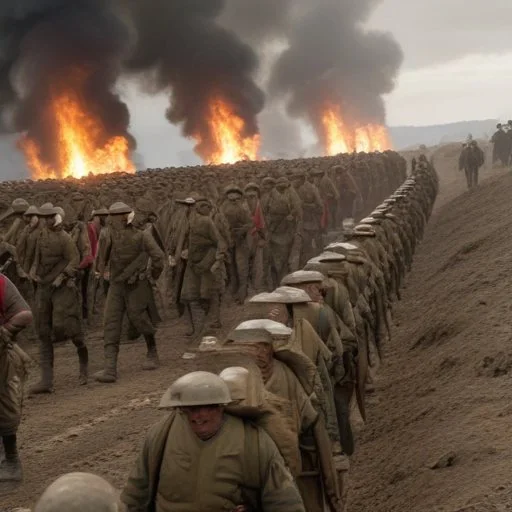
The Battle of the Somme was a pivotal military campaign fought during World War I, with the Allies attempting to relieve the French Army, which was under heavy pressure from the German forces at Verdun. The British Army, led by General Douglas Haig, planned a massive assault on the German trenches, hoping to break through the enemy lines and capture key strategic positions.
The British artillery bombardment of German positions began on June 24, 1916, with the aim of destroying enemy defenses. However, the bombardment proved ineffective, and the German trenches remained largely intact.
On July 1, 1916, at 7:30 am, the British infantry emerged from their trenches, expecting to find a broken and demoralized German army. Instead, they were met with a hail of machine-gun fire, artillery shells, and barbed wire that blocked their advance.
The horrific casualties on the first day of the Battle of the Somme shocked the British public and led to widespread outrage and grief. The high number of casualties also prompted a re-evaluation of military tactics, leading to changes in the way the British Army approached combat in the future.
The Somme campaign lasted for 141 days, resulting in over one million casualties on both sides. The battle ultimately failed to achieve its strategic objectives, but it did divert German resources away from Verdun and forced them to fight on multiple fronts.
The Somme disaster had a profound impact on British society, leading to widespread disillusionment with the war effort and the government. The tragedy also inspired a new wave of war poetry, with writers like Siegfried Sassoon and Wilfred Owen capturing the horrors and futility of trench warfare.
The Battle of the Somme was heavily criticized for its heavy-handed tactics, poor planning, and lack of coordination between British commanders. The catastrophic losses on the first day led to recriminations and finger-pointing, with many blaming General Haig for the disaster.
Despite the controversy, the Somme campaign played a significant role in shaping the course of World War I, forcing Germany to divert resources and ultimately contributing to their defeat.
"The Somme was a melancholy success—or, at least, a melancholy milestone on the long and disastrous road to victory." — Winston Churchill
Private Walter Butt, a British soldier who survived the first day of the Somme, recalled: "I saw men stumbling about, crying, and shouting for their mates... It was a sight I shall never forget."
The Somme disaster led to significant reforms in the British Army, including the development of new tactics and technologies, such as tanks and artillery coordination. These innovations would later influence the course of World War II and modern warfare.


The Battle of the Somme was the first time the British Army used tanks in combat.
The average weight of a British soldier's equipment on the first day of the Somme was around 70 pounds (32 kg).
The Somme campaign lasted for 141 days, making it one of the longest battles in World War I.
The bravery and sacrifice of the soldiers who fought on the Somme have inspired generations of Britons, serving as a testament to the nation's resilience and courage in the face of adversity.
Early Life and Military Career
General Douglas Haig was born on June 19, 1861, in Edinburgh, Scotland. He graduated from the Royal Military College at Sandhurst and went on to serve in the Sudan and South Africa, where he was awarded the Distinguished Service Order.
Rise to Prominence
Haig's military career was marked by a series of rapid promotions, and he became a lieutenant general by the age of 43. He played a key role in the planning and execution of the British Expeditionary Force's operations during World War I.
The Battle of the Somme had a profound impact on British culture, influencing art, literature, and music for generations to come.
Their poetic responses to the tragedy, such as Siegfried Sassoon's "The Survivors" and Wilfred Owen's "Dulce et Decorum Est," captured the horrors and futility of trench warfare.
The Somme also inspired a new wave of pacifist and anti-war movements, as people began to question the government's handling of the war effort.
The British and German armies employed vastly different tactics during the Battle of the Somme, leading to the devastating losses on the first day.
The British relied heavily on a prolonged artillery bombardment to weaken the German defenses, while the Germans focused on fortifying their trenches with barbed wire and machine-gun nests.
This mismatch in tactics ultimately led to the catastrophe that unfolded on July 1, 1916.

The Battle of the Somme marked a significant milestone in the development of modern warfare technology.
The introduction of tanks, which made their debut on September 15, 1916, revolutionized ground warfare and paved the way for future innovations in armored warfare.
The Somme also saw the widespread use of aircraft for reconnaissance and artillery spotting, further expanding the role of air power in modern warfare.
The Battle of the Somme presents a unique set of challenges for educators seeking to convey the complexities and horrors of World War I to modern students.
One approach is to focus on the personal stories of soldiers, such as Private Walter Butt, to humanize the conflict and make it more relatable to students.
Another strategy is to incorporate primary sources, such as diaries and letters, to provide students with a firsthand account of the battle.