


As the Allied forces closed in on Berlin, Adolf Hitler, the beleaguered Führer, found himself trapped in a cramped underground bunker, his once-formidable empire crumbling around him. It was amidst this desperation that he made a shocking decision: to marry his longtime partner, Eva Braun, in a hastily arranged ceremony that would mark the beginning of the end of the Third Reich.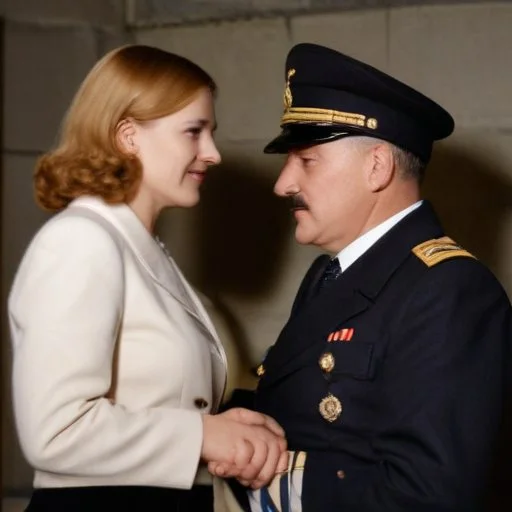
The unlikely marriage between Hitler and Braun serves as a testament to the Führer's rapidly disintegrating grip on reality. Braun, a former shopgirl and Hitler's companion for over a decade, had long been relegated to the shadows of the Nazi regime. Yet, as the Soviet army advanced on Berlin, Hitler's isolation deepened, and Braun's presence became a faint source of comfort in his increasingly paranoid world.
The ceremony itself was a far cry from the lavish spectacles that had once characterized the Nazi regime. Held in the dimly lit confines of the Führerbunker, the hastily arranged union was witnessed by a dwindling circle of loyalists, including propaganda minister Joseph Goebbels and his wife, Magda. The atmosphere was heavy with desperation, as the assembled group knew that this marriage marked the end of an era – and the beginning of the end for the Third Reich.
In a move that would have far-reaching consequences, Hitler named Admiral Karl Dönitz, the commander of the German Navy, as his successor. This surprise appointment marked a significant shift in power, as Dönitz, though a loyalist, was not a member of the Nazi inner circle. His ascension to the role of Führer would signal the beginning of a new era – one marked by surrender and defeat.
The marriage between Hitler and Braun serves as a poignant reminder of the human cost of war. As the Nazi regime collapsed, the once-omnipotent Führer was reduced to a desperate, isolated figure, clinging to the fragments of his crumbling empire. The union between Hitler and Braun serves as a powerful symbol of the devastating consequences of blind ambition and the corrupting influence of power.
In the aftermath of the war, the world was left to grapple with the enormity of the Nazi regime's atrocities. The marriage between Hitler and Braun, though a footnote in the grand tapestry of World War II, serves as a haunting reminder of the human frailty that lay at the heart of one of history's most destructive regimes.
As the curtain fell on the Third Reich, the world was left to ponder the devastating consequences of Hitler's reign. The unlikely marriage between the Führer and Eva Braun serves as a poignant epitaph to an era of terror, marking the end of a dark chapter in human history – and the beginning of a long, painful journey towards redemption.
Adolf Hitler's decision to marry Eva Braun was a surprise to many, but it was also a testament to the complex and tumultuous relationship they shared. Braun, a former shopgirl, had been Hitler's companion for over a decade, and had been relegated to the shadows of the Nazi regime. Despite her lack of formal education and political influence, Braun wielded significant emotional power over Hitler, who was known to be intensely paranoid and isolated.
As the war turned against Germany, Braun's presence became a comforting constant in Hitler's life, and he became increasingly reliant on her. The marriage, hastily arranged in the Führerbunker, was a desperate attempt to cling to normalcy in the face of impending defeat.
But Braun was more than just a comforting presence; she was also a symbol of Hitler's own mortality. As the Soviet army advanced on Berlin, Hitler was forced to confront the reality of his own death, and Braun's presence served as a reminder that even the most powerful men are not immune to fate.

The marriage between Adolf Hitler and Eva Braun has been the subject of much historical debate and speculation. Some historians have viewed the union as a symbol of Hitler's desperation and isolation, while others have seen it as a calculated move to secure Braun's silence and loyalty in the face of impending defeat.
However, recent scholarship has shed new light on the complexities of the Hitler-Braun relationship, revealing a dynamic that was both intensely personal and deeply political. By examining the marriage through the lens of historical context, we can gain a deeper understanding of the psychological and emotional dynamics that drove Hitler's decision-making in the final days of the war.
Ultimately, the marriage between Hitler and Braun serves as a poignant reminder of the human cost of war, and the devastating consequences of blind ambition and the corrupting influence of power.
The marriage between Adolf Hitler and Eva Braun took place against the backdrop of a rapidly shifting geopolitical landscape. As the Soviet army advanced on Berlin, the Allied forces were closing in from the west, and the once-mighty Third Reich was on the brink of collapse.
In this context, Hitler's decision to marry Braun can be seen as a desperate attempt to cling to power and influence, even as the Nazi regime was crumbling around him. The union was a symbol of Hitler's refusal to accept defeat, and his determination to maintain control over the fragmented remains of his empire.
However, the marriage also served as a tacit acknowledgement of the regime's impending collapse, and the beginning of a new era in European geopolitics. As the Nazi regime crumbled, the Soviet Union emerged as the dominant power in Eastern Europe, and the stage was set for the Cold War.

The marriage between Adolf Hitler and Eva Braun serves as a powerful symbol of the devastating consequences of war and the corrupting influence of power. The union, hastily arranged in the Führerbunker, was a desperate attempt to cling to normalcy in the face of impending defeat, and it marked the beginning of the end of the Third Reich.
As the news of the marriage spread, it sent shockwaves through Germany and beyond, serving as a poignant reminder of the human cost of war. The union between Hitler and Braun was a powerful symbol of the devastating consequences of blind ambition, and the corrupting influence of power.
In the aftermath of the war, the marriage between Hitler and Braun served as a cultural touchstone, symbolizing the darkness and desperation of the Nazi regime. It has been the subject of numerous films, books, and artworks, and continues to fascinate and horrify people to this day.
The marriage between Adolf Hitler and Eva Braun had significant economic implications, both in the short and long term. In the immediate aftermath of the war, the Allied forces imposed severe economic sanctions on Germany, crippling the country's economy and paving the way for a long period of reconstruction and recovery.
In the long term, the fall of the Nazi regime marked a significant shift in the global economic landscape. The United States emerged as a dominant economic power, while the Soviet Union began to consolidate its control over Eastern Europe. The division of Europe into East and West had significant economic implications, shaping the course of global trade and commerce for decades to come.
The marriage between Hitler and Braun serves as a poignant reminder of the devastating consequences of war, and the far-reaching economic implications of military conflict.