


In the dying days of World War II, as the Allies closed in on Germany from all sides, a desperate attempt was made to establish a new government in the northern city of Flensburg. Led by Admiral Karl Dönitz, this government was destined to be short-lived, and its dissolution marked the ultimate defeat of Nazi Germany.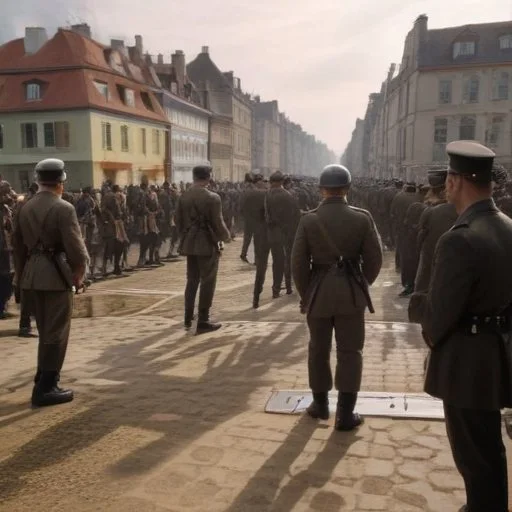
As the war in Europe drew to a close, Dönitz, who had been appointed as Hitler's successor, sought to establish a new government that would be recognized by the Allies. He saw this as a way to salvage what was left of Germany's dignity and potentially negotiate a more favorable surrender.
On May 2, 1945, Dönitz and his cabinet established the Flensburg Government, which was little more than a government in exile. Operating from a naval academy in Flensburg, they attempted to assert their authority over what was left of Germany. However, this government lacked any real power and was largely symbolic.
The Allies, particularly the British, were not fooled by Dönitz's attempts to establish a new government. On May 23, 1945, British forces arrested Dönitz and his cabinet, effectively dissolving the Flensburg Government and bringing an end to the war in Europe.
The dissolution of the Flensburg Government marked the final defeat of Nazi Germany and paved the way for the country's occupation by the Allies. The event also led to the trial and conviction of key Nazi officials, including Dönitz, at the Nuremberg Trials.
The Flensburg Government's brief existence had a significant impact on the cultural and social landscape of post-war Germany. The event marked a turning point in the country's history, as it began to come to terms with its role in the war and the atrocities committed by the Nazi regime.
"We must build a new Germany, a Germany that is worthy of respect and friendship from the entire world." - Admiral Karl Dönitz, in a speech to the Flensburg Government.
This quote, though uttered in a desperate attempt to salvage Germany's dignity, reflects the country's desire to rebuild and redeem itself in the eyes of the world.
The Flensburg Government's brief existence was a desperate attempt to cling to power in the face of overwhelming defeat. Though it ultimately failed, the event marked a significant turning point in world history and paved the way for Germany's post-war reconstruction.
Admiral Karl Dönitz, a career naval officer, was thrust into the spotlight as Hitler's successor. Despite his reluctance, he accepted the role, driven by a sense of duty and loyalty to Germany. His leadership style was marked by caution and pragmatism, as he navigated the treacherous waters of Nazi politics.
Dönitz's background in the naval academy and his experience as a U-boat commander shaped his approach to governance. He was known for his attention to detail and his ability to inspire loyalty among his troops. However, his lack of experience in state politics and his limited understanding of the broader geo-political landscape hindered his ability to effectively lead the Flensburg Government.
The Flensburg Government emerged in the midst of a rapidly shifting geopolitical landscape. As the Allies closed in on Germany, the country was torn apart by internal divisions and external pressures.
The Soviet Union's rapid advance on the Eastern Front had pushed Germany to the brink of collapse, while the Western Allies continued to push from the West. This created a power vacuum that Dönitz and his government attempted to fill.
The Flensburg Government's existence was further complicated by the differing interests of the Allied powers. While the Western Allies sought to negotiate a surrender, the Soviet Union demanded unconditional surrender and occupation.
The Flensburg Government's brief existence had a profound impact on German culture and society. The event marked a turning point in the country's history, as it began to come to terms with its role in the war and the atrocities committed by the Nazi regime.
The government's dissolution paved the way for the Allied occupation, which brought with it a period of denazification and re-education. This process aimed to purge German society of Nazi ideology and promote a new era of democratic values.
The Flensburg Government's legacy can also be seen in the development of modern German identity. The country's post-war reconstruction was marked by a renewed emphasis on democracy, human rights, and international cooperation.
The Flensburg Government was characterized by intense political manoeuvring, as Dönitz and his cabinet sought to maintain power in the face of overwhelming defeat.
The government's existence was marked by a series of backroom deals and secret negotiations, as officials attempted to secure favorable treatment from the Allies.
Despite these efforts, the government ultimately failed to achieve its goals, and its dissolution marked the final defeat of Nazi Germany. The Flensburg Government's political machinations serve as a cautionary tale about the dangers of authoritarianism and the importance of democratic accountability.
Historians have long debated the significance of the Flensburg Government, with some viewing it as a desperate attempt to cling to power and others seeing it as a genuine effort to negotiate a peaceful surrender.
Some historians have argued that the Flensburg Government was a manifestation of the Nazi regime's inherent contradictions, as officials attempted to reconcile their ideological beliefs with the harsh realities of defeat.
Others have seen the Flensburg Government as a microcosm of the broader themes of World War II, including the struggle for power, the dangers of ideology, and the importance of democratic governance.