


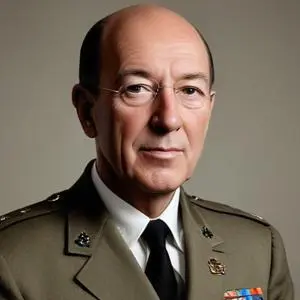
A decorated soldier, politician, and diplomat who served as the 5th United States Ambassador to the United Nations, known for his eloquence and advocacy for international cooperation. He was a two-time presidential candidate, promoting progressive policies and civil rights.
Adlai Stevenson II was a renowned American politician and diplomat who left an indelible mark on the country's foreign policy and international relations. As the 31st governor of Illinois, Democratic presidential nominee, and United States Ambassador to the United Nations, Stevenson's commitment to public service spanned over three decades.
Throughout his illustrious career, Stevenson was a champion of progressive values, advocating for social justice, human rights, and international cooperation. His diplomatic prowess and eloquence earned him the respect of world leaders, making him a trusted voice in global affairs.
Born on February 5, 1900, in Los Angeles, California, Stevenson came from a family steeped in politics. His grandfather, Adlai Stevenson I, served as the 23rd Vice President of the United States. Thisfamily legacy instilled in Stevenson a strong sense of public duty and a passion for politics.
After graduating from Princeton University and Northwestern University School of Law, Stevenson embarked on a career in public service. He worked in the Agricultural Adjustment Administration, Federal Alcohol Administration, Department of the Navy, and the State Department, honing his diplomatic skills and gaining valuable experience in international relations.
In 1948, Stevenson was elected governor of Illinois, defeating incumbent Dwight H. Green in an upset victory. As governor, he implemented a range of reforms, including:
Stevenson's progressive policies and leadership earned him national recognition, leading to his selection as the Democratic nominee for president in 1952 and 1956. Although he lost both elections to Dwight D. Eisenhower, Stevenson's campaign platforms emphasized social justice, economic development, and international cooperation.
In 1961, President John F. Kennedy appointed Stevenson as the United States Ambassador to the United Nations. During his tenure, Stevenson played a crucial role in several high-stakes crises, including:
Stevenson's diplomatic acumen and ability to navigate complex international relationships helped to de-escalate tensions and prevent global conflict.
Adlai Stevenson II's life and legacy continue to inspire generations of politicians, diplomats, and public servants. His commitment to progressive values, social justice, and international cooperation has left a lasting impact on American foreign policy and the United Nations.
As a testament to his influence, Stevenson was posthumously awarded the Presidential Medal of Freedom in 1965. His life's work serves as a reminder of the power of diplomacy, statesmanship, and public service.
In the words of Adlai Stevenson II, "The time to stop talking is when the other person is afraid that you will not talk."
His legacy endures, inspiring future generations to continue his work in promoting peace, understanding, and global cooperation.
Born in 1917
The 35th President of the United States was a charismatic leader who navigated the country through the Cuban Missile Crisis and advocated for civil rights, leaving a lasting legacy in American politics.
Born in 1890
Led the Allied forces to victory in World War II and later served as President, maintaining peace and prosperity during the Cold War era. He's known for his strategic leadership and diplomatic skills.
Born in 1884
The 33rd President of the United States, a strong leader who made tough decisions, including dropping atomic bombs on Japan and establishing the Marshall Plan to rebuild Europe after WWII.
Born in 1913
The 37th President of the United States, a polarizing figure who led the country through significant domestic and foreign policy changes, infamous for his involvement in the Watergate scandal.
Born in 1911
The 38th Vice President of the United States was a prominent liberal politician and journalist who played a key role in shaping the country's civil rights policies. He's most known for his strong support of the Civil Rights Act of 1964.
Born in 1908
The 36th President of the United States, a skilled politician and leader, played a crucial role in passing landmark civil rights legislation, including the Civil Rights Act and Voting Rights Act.
Born in 1884
A humanitarian and politician who championed human rights, women's empowerment, and social justice, leaving a lasting impact on American politics and international relations.
Born in 1901
The first Secretary of the Air Force, instrumental in shaping the US Air Force into a separate branch, and a key figure in the country's military aviation development.
