


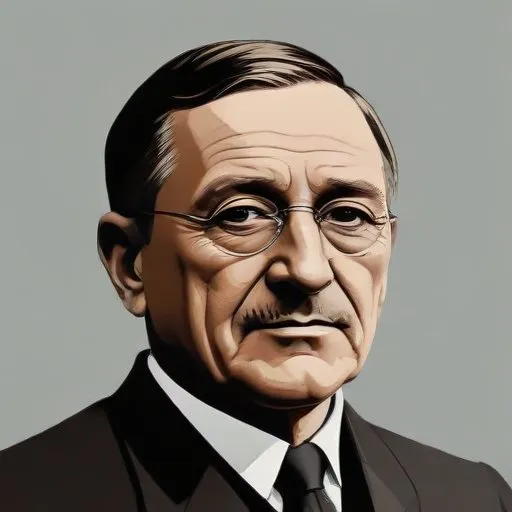
A German economist and educator who developed innovative educational methods and advocated for social and economic reform, particularly in the context of the German resistance against Nazism.
Adolf Reichwein was a German educator, economist, and cultural policymaker who resisted the oppressive policies of Nazi Germany, leaving an indelible mark on the country's educational landscape. Through his innovative approaches to teaching and learning, Reichwein championed the cause of progressive education, empowering students to become active participants in the learning process.
Born on October 3, 1898, in Bad Ems, Reichwein's early life was marked by service in the First World War, where he suffered serious lung injuries. Despite these challenges, he pursued his passion for education, studying at the universities of Frankfurt am Main and Marburg under the guidance of renowned scholars Hugo Sinzheimer and Franz Oppenheimer.
In the 1920s, Reichwein's dedication to education policy and adult education led him to establish the Volkshochschule (People's High School) and the Arbeiterbildungsheim (Workers' Training Home) in Jena. These institutions embodied his vision of education as a transformative force, providing opportunities for personal growth and social mobility.
In 1929-1930, Reichwein embarked on the Hungermarsch nach Lappland (Hunger March to Lappland), a grueling hike with young jobless people in the far north. This experience inspired his diary, which became a powerful testament to the resilience of the human spirit in the face of adversity.
From 1930 to 1933, Reichwein served as a professor at the Pedagogical Academy in Halle, where he developed his instructional concept, inspired by the Wandervogel movement and labor school pedagogy. His emphasis on trips, activity-oriented instruction, and projects spanning age groups sparked controversy and admiration in equal measure.
After the Nazi seizure of power, Reichwein was dismissed from his professorship due to his political views and relegated to teaching elementary school in Tiefensee, Brandenburg. Undeterred, he continued to experiment with innovative instructional methods, focusing on educational progressivism and vocational education.
Reichwein's remarkable journey serves as a testament to the power of courage and conviction in the face of adversity. Through his unwavering commitment to progressive education, he inspired generations of educators and students, leaving an indelible mark on the cultural and educational landscape of Germany.
Reichwein's vision of education as a transformative force continues to inspire educators and policymakers around the world. His emphasis on experiential learning, community engagement, and social responsibility has influenced generations of educators, shaping the contours of modern education.
Reichwein's life and work serve as a powerful reminder of the importance of educational progressivism and social responsibility. His defiance of Nazi tyranny and his commitment to empowering students continue to inspire educators, policymakers, and individuals around the world.
Born in 1883
A pioneer of innovation theory, he's credited with coining the term "creative destruction" to describe how new technologies and businesses disrupt existing ones, driving economic growth and progress.
Born in 1883
A pioneering economist who revolutionized modern economic theory with his groundbreaking ideas on government intervention and fiscal policy, shaping global economic policies.
Born in 1899
Austrian economist and philosopher who championed free market capitalism and limited government intervention, warning of the dangers of socialism and totalitarianism. His work influenced economic policy and shaped modern libertarian thought.
Born in 1912
A Nobel Prize-winning economist who championed free market capitalism and limited government intervention, known for his advocacy of laissez-faire economics and influential writings on monetary policy.
Born in 1881
A pioneer of Austrian economics, he developed the concept of praxeology, which focuses on human action and its consequences, and is known for his critiques of socialism and central planning.
Born in 1818
A 19th-century philosopher who developed the theory of communism, arguing that capitalism would eventually be replaced by a socialist society. He's known for his critique of capitalism and the concept of class struggle.
Born in 1908
A renowned economist and diplomat who served as the 7th United States Ambassador to India, known for his influential works on economics, particularly "The Affluent Society" and "The New Industrial State".
Born in 1915
A renowned economist and academic who made significant contributions to the field of economics, particularly in the areas of macroeconomics and international trade. He was awarded the Nobel Prize in Economics in 1970.
