


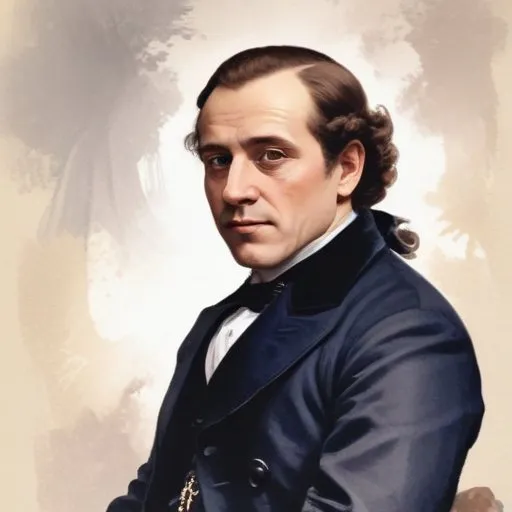
A master of Realism, he captured the essence of 19th-century German life through vivid, detailed paintings and illustrations, often focusing on industrial and military scenes.
Adolph Menzel, born on December 8, 1815, was a German Realist artist renowned for his captivating drawings, etchings, and paintings thatcontinue to mesmerize art enthusiasts to this day. Alongside Caspar David Friedrich, Menzel is regarded as one of the two most prominent German painters of the 19th century, leaving an indelible mark on the art world.
Menzel was born in Breslau, Prussian Silesia (present-day Wrocław, Poland), to German parents. His father, a lithographer, encouraged Menzel's artistic inclinations, but initially intended for him to become a professor. After his father's death in 1832, Menzel took over the family's lithographic business, but his passion for art led him to study briefly at the Berlin Academy of Art in 1833.
Menzel's talent and dedication earned him recognition, and in 1833, Louis Friedrich Sachse of Berlin published his first work, an album of pen-and-ink drawings illustrating Goethe's poem, "Künstler Erde". This marked the beginning of Menzel's illustrious career, which would span over six decades.
Menzel's artistic style was characterized by his ability to capture the subtleties of light and shadow, often using everyday life as his subject matter. His paintings and drawings depicted scenes from German history, landscapes, and genre scenes, showcasing his remarkable skill in conveying atmosphere and mood.
Some of Menzel's most notable works include "The Iron Rolling Mill" (1872-1875), "The Flute Concert of Frederick the Great at Sanssouci" (1852), and "The Palace of Frederick the Great in Sanssouci" (1852-1853). These masterpieces, along with his numerous etchings and drawings, have secured Menzel's place as one of the most celebrated artists of the 19th century.
In recognition of his outstanding contributions to the art world, Menzel was knighted in 1898, changing his name to Adolph von Menzel. He received numerous awards and accolades throughout his career, cementing his status as a German national treasure.
Despite his success, Menzel's personal life was marked by a sense of detachment. He stood at only 4 feet 6 inches tall and had a large head, which may have contributed to his feelings of social estrangement. Nevertheless, he maintained numerous friendships and connections within the artistic community.
Adolph Menzel's artistic legacy extends far beyond his native Germany. His work has inspired generations of artists, and his influence can be seen in various aspects of modern art, from Realism to Impressionism. Today, his paintings and drawings continue to captivate audiences, solidifying his position as one of the most significant artists of the 19th century.
Adolph Menzel's remarkable life and artistic career serve as a testament to his dedication, perseverance, and innovative spirit. His legacy continues to inspire and educate art enthusiasts, ensuring his place as one of the greatest artists of all time.
Born in 1833
A renowned pianist and composer, he crafted complex, expressive works that blended traditional and innovative techniques, leaving an indelible mark on classical music.
Born in 1819
A 19th-century literary mastermind, renowned for crafting poignant novels and poetry that explored the human condition, particularly in the context of German society during the late 1800s.
Born in 1830
A German literary mastermind, renowned for his poetic and dramatic works that explored the human condition, earning him the Nobel Prize in Literature in 1910.
Born in 1831
A 19th-century German literary realist, known for his vivid depictions of everyday life and social commentary through novels and paintings. His works offer a glimpse into the lives of ordinary people during the German Empire era.
