


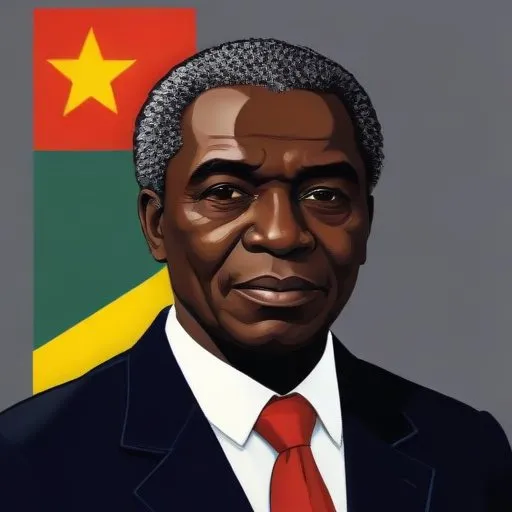
Angola's first president and a celebrated poet, he led the country to independence from Portugal and is revered for his nationalistic and literary contributions.
Agostinho Neto was a renowned Angolan communist politician and poet who served as the first president of Angola from 1975 to 1979, leading the country to independence from Portuguese colonial rule. He is also celebrated as Angola's preeminent poet, and his birthday, September 17, is commemorated as National Heroes Day, a public holiday in Angola.
Neto was born on September 17, 1922, in Icolo e Bengo, Bengo Province, Angola, to a family of school teachers and Methodists. His father, also named Agostinho Neto, was a Methodist pastor. After completing high school in Luanda, Neto worked in the colonial health services before pursuing higher education in Portugal.
At the universities of Coimbra and Lisbon, Neto studied medicine while engaging in clandestine political activities, which led to his arrests in 1951, 1952, and 1955 by the Portuguese security police, PIDE, for his separatist activism. Despite these setbacks, Neto finished his studies and married a 23-year-old Portuguese woman, Maria Eugnia da Silva, on the day of his graduation.
In 1959, Neto returned to Angola and was arrested again in 1960. However, he escaped and assumed leadership of the armed struggle against colonial rule. In 1961, he became the president of the Popular Movement for the Liberation of Angola (MPLA), a position he held until his death in 1979.
Under Neto's leadership, the MPLA played a crucial role in Angola's war for independence, which lasted from 1961 to 1974. After Angola gained independence in 1975, Neto became the country's first president, a position he held until his death in 1979. During his presidency, Neto led the MPLA in the civil war that lasted from 1975 to 2002.
Neto's poetry is deeply rooted in African nationalism and the struggle for independence. His works are characterized by their use of emotive language, powerful imagery, and strong political messaging. Some of his notable poetic works include "Quatro Poemas de Quatro" and " Sagrada Esperança" (Sacred Hope).
Neto's poetry has been widely acclaimed, and he is regarded as one of the most important African poets of the 20th century. His literary contributions have been recognized with several awards, including the Lotus Prize for Literature in 1971.
Agostinho Neto's legacy extends beyond his literary and political achievements. He is remembered as a national hero who led Angola to independence and self-determination. His commitment to African nationalism and socialism continues to inspire generations of Africans and people around the world.
In Angola, Neto's birthday is celebrated as National Heroes Day, a public holiday that honors his contributions to the country's struggle for independence. His legacy also extends to the MPLA, which remains one of the dominant political parties in Angola.
Some of Neto's notable quotes include:
Neto's legacy continues to have a profound impact on modern society. His commitment to African nationalism and socialism has inspired movements for self-determination and independence around the world. His poetry has also inspired generations of writers, artists, and musicians.
In Angola, Neto's legacy has contributed to the country's continued development and growth. The MPLA, which he led, remains a dominant political force in the country, and his poetry continues to inspire Angolans and people around the world.
Born in 1889
A dictator who ruled Portugal from 1933 to 1968, implementing a corporatist authoritarian regime and maintaining a neutral stance during World War II. He's known for his economic reforms and nationalist policies.
Born in 1924
A Portuguese historian, lawyer, and politician who served as the 17th President of Portugal, known for leading the country's transition from authoritarianism to democracy. He played a key role in Portugal's decolonization and European integration.
72 Years Old
The 3rd President of Angola, a key figure in the country's transition to democracy, known for his efforts to rebuild and stabilize the nation after decades of civil war.
Born in 1924
African revolutionary and founder of Guinea-Bissau, leading the country to independence from Portugal through a decade-long guerrilla war. He's revered for his pan-Africanist vision and anti-colonial leadership.
Born in 1901
The architect of apartheid, known for implementing and enforcing the racist segregation policies in South Africa from 1958 to 1966. His policies had a profound impact on the country's social and political landscape.
97 Years Old
The first President of Namibia, who led the country to independence from South African rule and served as a symbol of national unity, is most known for his role in the country's struggle for freedom. He is a prominent figure in African politics and a champion of liberation movements.
Born in 1922
First President of Tanzania, led the country to independence from British colonial rule and implemented socialist policies, known for his Pan-Africanism and anti-colonialism efforts.
