


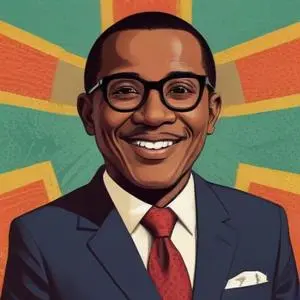
African revolutionary and founder of Guinea-Bissau, leading the country to independence from Portugal through a decade-long guerrilla war. He's revered for his pan-Africanist vision and anti-colonial leadership.
Amlcar Cabral, a Bissau-Guinean and Cape Verdean agricultural engineer, political organizer, and diplomat, is renowned for his tireless efforts in spearheading the nationalist movement of Guinea-Bissau and the Cape Verde Islands, ultimately leading to the war of independence in Guinea-Bissau.
As one of Africa's foremost anticolonial leaders, Cabral's revolutionary ideology and intellectual nationalist perspective inspired generations of socialists and national independence movements worldwide, earning him the nom de guerre Abel Djassi.
Born on 12 September 1924, in the town of Bafat, Portuguese Guinea (now Guinea-Bissau), Cabral was the son of Cape Verdean parents, Juvenal Antnio Lopes da Costa Cabral and Iva Pinhel vora.
His mother, a shop owner and hotel worker, played a significant role in supporting the family, particularly after separating from his father in 1929.
Cabral's educational journey began at Liceu Secondary School Gil Eanes in Cape Verde, followed by the Instituto Superior de Agronomia in Lisbon, Portugal, where he founded student movements opposing the ruling dictatorship of Portugal and promoting independence for the Portuguese colonies in Africa.
Returning to Africa in 1953, Cabral conducted an agricultural census in Portuguese Guinea, traveling over 60,000 kilometers and becoming intimately familiar with the people and land.
This experience instilled in him a deep understanding of the region's socio-economic complexities, which he would later leverage to mobilize the masses against colonial rule.
In 1956, Cabral co-founded the African Party for the Independence of Guinea and Cape Verde (PAIGC), a revolutionary party dedicated to achieving independence through armed struggle.
Through his leadership, Cabral orchestrated a series of successful military campaigns, weakening the Portuguese colonial grip on Guinea-Bissau and paving the way for the country's eventual independence.
Cabral's philosophical beliefs were deeply rooted in Marxism, which influenced his revolutionary ideology and nationalist vision for a unified Africa.
As a pan-Africanist, Cabral believed in the unity and solidarity of African nations, advocating for the recognition of African identity and the rejection of colonialism.
Although assassinated on 20 January 1973, eight months before Guinea-Bissau's unilateral declaration of independence, Cabral's legacy continues to inspire generations of Africans and socialists worldwide.
His contributions to the struggle for independence, his commitment to pan-Africanism, and his unwavering dedication to the principles of socialism have cemented his place as one of the most influential figures in African history.
Cabral's fight for independence took place during a period of intense global decolonization, as African nations sought to break free from European colonial rule.
In comparison to other prominent African independence leaders, such as Kwame Nkrumah of Ghana and Amílcar Fanjul of Angola, Cabral's ideology was uniquely shaped by his Marxist and pan-Africanist perspectives.
In recognition of his remarkable contributions to the struggle for independence and African unity, Cabral was posthumously awarded the Order of Amílcar Cabral, the highest national honor in Guinea-Bissau.
Today, his legacy continues to inspire new generations of Africans, cementing his place as one of the most influential figures in African history.
Born in 1924
African revolutionary and founder of Guinea-Bissau, leading the country to independence from Portugal through a decade-long guerrilla war. He's revered for his pan-Africanist vision and anti-colonial leadership.
Born in 1909
First President of Ghana, leading the country to independence from British colonial rule and promoting Pan-Africanism. He's known for his vision of a united Africa and his role in shaping modern Ghana.
Born in 1922
First President of Tanzania, led the country to independence from British colonial rule and implemented socialist policies, known for his Pan-Africanism and anti-colonialism efforts.
Born in 1925
The first Prime Minister of the Democratic Republic of the Congo, a key figure in the country's struggle for independence from Belgium, and a symbol of African nationalism. He played a crucial role in shaping the country's early years, but his life was cut short by assassination.
Born in 1926
The Cuban revolutionary who led the country from 1959 to 2008, implementing socialist policies and defying US opposition, becoming an iconic figure in modern history.
72 Years Old
The charismatic leader who transformed Venezuela through socialist reforms and anti-imperialist rhetoric, leaving a lasting impact on the country's politics and economy.
Born in 1918
A South African lawyer and politician who fought against apartheid, becoming the country's first black president and a symbol of racial reconciliation, earning a Nobel Peace Prize. He's a beacon of hope and freedom.
