


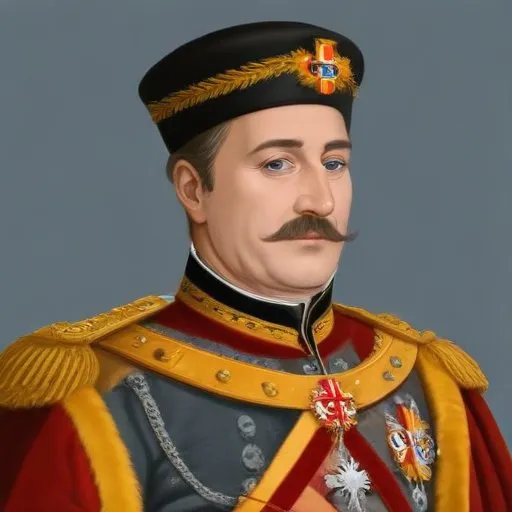
Ruler of Bavaria from 1465 to 1508, known for his attempts to consolidate power and unify the fragmented duchy. He also played a key role in the War of the Succession of Landshut.
Albert IV, Duke of Bavaria, is remembered for his remarkable achievement of reunifying the fragmented territories of Bavaria, bringing an end to centuries of division and conflict. Born on December 15, 1447, in Munich, Albert was destined to play a crucial role in shaping the history of Bavaria, leaving behind a lasting legacy that would be felt for generations to come.
Albert's journey to power began after the death of his older brother, John IV, Duke of Bavaria. He gave up his spiritual career and returned from Pavia to Munich, where he started to build his influence. When his brothers Christoph and Wolfgang resigned, Albert became the sole duke, but a new duchy, Bavaria-Dachau, was created from Bavaria-Munich for his brother Duke Sigismund in 1467.
Albert's marriage to Kunigunde of Austria was a result of intrigue and deception. He illegally took control of some imperial fiefs and offered to give them to Kunigunde as a dowry in exchange for her hand in marriage. Although Emperor Frederick III initially agreed, he later withdrew his consent after Albert took control of another fief, Regensburg. However, Albert married Kunigunde on January 2, 1487, before the emperor's change of heart could be communicated to his daughter. The marriage was only prevented from escalating into war through the intermediation of the emperor's son, Maximilian I.
In 1491-1492, Albert fought against the rebellious Lüwlerbund. He eventually decided to return territorial acquisitions in Swabia in 1492 to avoid a war with the Habsburg and the Swabian League. Albert then had to release Regensburg, which had been reunited with Bavaria in 1486, and reluctantly renounced Further Austria when Archduke Sigismund of Austria tried to make it over to Albert.
After the death of the last duke of Bavaria-Landshut, George, in 1503, Albert seized the opportunity to reunite the whole of Bavaria. He fought a brutal war against George's heirs, the Palatinate, and eventually succeeded in uniting the fragmented territories of Bavaria under his rule.
Through his life and times, Albert IV, Duke of Bavaria, proved himself to be a shrewd politician, a skilled military leader, and a visionary who dared to dream of a united Bavaria. His legacy continues to inspire and influence the people of Bavaria to this day.
Born in 1365
Ruler of Bavaria from 995 to 1004, known for his military campaigns and territorial expansions, particularly in the region of Carinthia.
Born in 1229
A king who ruled Bavaria from 1864 to 1886, known for his eccentric behavior, extravagant spending, and commissioning of fairytale-like castles, including Neuschwanstein Castle.
Born in 1604
A 17th-century nobleman who ruled Lorraine and was involved in various European conflicts, including the Thirty Years' War. He's also known for his cultural achievements, such as promoting arts and architecture.
