


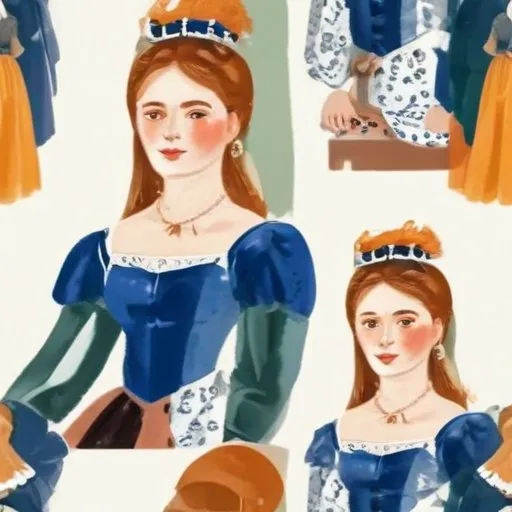
A 16th-century Habsburg princess who married into the Wittelsbach dynasty, becoming a powerful duchess and patron of the arts in Bavaria, known for her cultural and political influence.
Known for her unconventional upbringing and her marriage to Albert IV, Duke of Bavaria, Kunigunde of Austria left an indelible mark on the history of Bavaria and Austria. As the fourth child and second daughter of Emperor Frederick III and Eleanor of Portugal, Kunigunde's life was marked by intrigue, politics, and a desire to chart her own course.
Born on March 16, 1465, in Wiener Neustadt, Kunigunde was raised in an informal and open atmosphere, far removed from the rigid court etiquette of the time. Her father, Emperor Frederick III, took a keen interest in her upbringing, removing her from her mother's care when she fell ill, and instead, raising her in his own bedchamber. This unorthodox approach to childcare had a lasting impact on Kunigunde, shaping her into a strong-willed and independent individual.
Kunigunde received an education that was uncommon for women of her time. She learned to read, write, and embroider, but also developed skills in riding, hunting, astronomy, and mathematics. This broad range of interests and skills set her apart from her contemporaries and paved the way for her future roles as a duchess and a leader.
As a member of the House of Habsburg, Kunigunde was involved in the political intrigues of her time from a young age. In 1470, King Matthias Corvinus of Hungary requested her hand in marriage, but Emperor Frederick III refused, fueled by his own rivalries with Corvinus for the Crown of Saint Stephen and the Lands of the Bohemian Crown. Instead, Kunigunde married Albert IV, Duke of Bavaria, in 1487, becoming the Duchess of Bavaria.
Kunigunde's marriage to Albert IV marked the beginning of a new era in Bavaria, with the Habsburgs and Wittelsbachs forming a powerful alliance. As Duchess of Bavaria, Kunigunde played a significant role in shaping the region's politics, culture, and economy. Her influence extended beyond the borders of Bavaria, with her marriage helping to cement alliances and secure peace in the region.
Kunigunde's life was marked by her determination to forge her own path, defying convention and pushing boundaries. Through her education, interests, and marriage, she left an indelible mark on the history of Austria and Bavaria, cementing her place as one of the most fascinating and influential women of her time.
Born in 1471
A Renaissance master of intricate woodcuts and engravings, known for precise and detailed depictions of nature and human form, influencing art and mathematics for centuries.
Born in 1643
A 17th-century nobleman who ruled Lorraine and played a significant role in the Thirty Years' War, known for his military campaigns and territorial expansions.
Born in 1438
Ruler of Savoy from 1496 to 1497, known for his brief but tumultuous reign marked by conflicts with neighboring states and internal power struggles.
Born in 1552
The eccentric and reclusive ruler of the Holy Roman Empire, known for his fascination with alchemy, astrology, and the occult, and his patronage of artists and intellectuals.
92 Years Old
The King of the Belgians from 1993 to 2013, known for his efforts to unify the country and promote economic growth, as well as his role in shaping the European Union.
Born in 1616
A German nobleman who ruled a state in the Holy Roman Empire and was a skilled military leader, known for his bravery and strategic thinking during the War of the Austrian Succession.
