


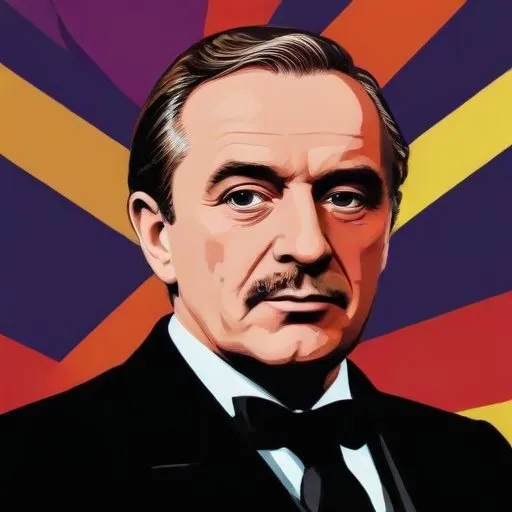
A prominent businessman and politician who served as President of the Board of Trade, playing a significant role in shaping Britain's economy and transportation systems. He's also credited with developing the London Underground.
Albert Stanley, 1st Baron Ashfield, was the driving force behind the transformation of London's transport system in the early 20th century. As the managing director and chairman of the Underground Electric Railways Company of London (UERL) and later the London Passenger Transport Board (LPTB), Stanley played a crucial role in shaping the city's transportation network, earning him a reputation as one of the most influential figures in British transport history.
Stanley was born Albert Henry Knattriess on August 8, 1874, in New Normanton, Derbyshire, England. His family emigrated to Detroit, United States, in 1880, where he began his career in the tramway industry. He quickly rose through the ranks, holding senior positions in Detroit and New Jersey's tramway systems. In 1898, he served in the United States Navy during the Spanish-American War.
In 1907, Stanley's management skills caught the attention of the UERL, which was struggling to stay afloat. He was recruited to lead the company, and in 1910, he became its managing director. Under his leadership, the UERL underwent a significant transformation, with Stanley implementing innovative advertising and public relations strategies to boost profits.
Stanley's vision for an integrated transport network led to the takeover of competing underground railway companies and bus and tram operations. This bold move resulted in the creation of the "Combine," a comprehensive transport system that would become the hallmark of London's transportation network.
Stanley's success in the transport industry did not go unnoticed. He was elected Member of Parliament for Ashton-under-Lyne from 1916 to 1920 and served as President of the Board of Trade from 1916 to 1919. During this period, he reorganized the board and established specialist departments for various industries. In recognition of his contributions, Stanley was raised to the peerage as 1st Baron Ashfield in 1920.
Stanley's legacy extends far beyond his tenure at the UERL and LPTB. He played a pivotal role in shaping London's transport network, which has since become a model for cities around the world. His innovative approaches to transportation management and his commitment to public service have inspired generations of transport professionals.
In addition to his transport career, Stanley was a strong advocate for education and social welfare. He served as a governor of the London School of Economics and was involved in various charitable organizations.
"The transport problem is not just a question of moving people from one place to another; it is a question of creating a better life for the people of London." - Albert Stanley, 1st Baron Ashfield
Born in 1871
Prolific writer of historical novels and adventure stories, also a talented landscape painter.
Born in 1863
A Welsh lawyer and politician who served as Prime Minister of the United Kingdom, leading the country through World War I and introducing key social reforms. He's known for his charismatic leadership and progressive policies.
Born in 1858
A Canadian-Scottish banker and politician who served as Prime Minister of the United Kingdom during World War I, known for his leadership during wartime and his role in shaping British politics.
Born in 1866
A Scottish journalist and politician who served as the first Labour Party Prime Minister of the United Kingdom, leading the country through significant economic and social reforms. He is also known for his efforts to maintain peace in Europe during the interwar period.
Born in 1867
A conservative leader who served as Prime Minister three times, known for his role in navigating Britain through economic crises and advocating for imperial protectionism.
Born in 1869
The Prime Minister who infamously appeased Nazi Germany with the Munich Agreement, hoping to avoid war, but ultimately contributing to its outbreak. He's a symbol of failed diplomacy and naivety in the face of aggression.
Born in 1883
Led the Labour Party to a landslide victory in 1945, implementing significant social and economic reforms, including the creation of the National Health Service. He played a crucial role in shaping post-war Britain.
