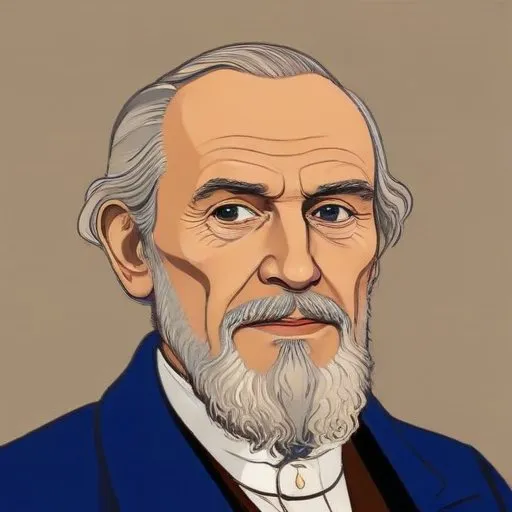
Aleksey Konstantinovich Tolstoy: The Russian Literary Icon
A Pioneer of Historical Dramas
Aleksey Konstantinovich Tolstoy, often referred to as A.K. Tolstoy, was a renowned Russian poet, novelist, and playwright who left an indelible mark on the world of literature. He is best known for his extraordinary historical dramas, which continue to captivate audiences with their rich historical context and literary flair.
A Family Legacy of Literary Excellence
Born on September 5, 1817, in St. Petersburg, Russia, Tolstoy was a member of the esteemed Tolstoy family, and a second cousin of the celebrated author
Leo Tolstoy. His mother's close ties with the court of Tsar Alexander II granted him access to the Crown Prince's childhood entourage, where he became a comrade in games for the young royal.
Tolstoy's travels to Italy and Germany had a profound impact on his writing. It was during these journeys that he met the legendary German writer Johann Wolfgang von Goethe, who instilled in him a deep appreciation for the power of literature.
Tolstoy began his education at home under the tutelage of his uncle, the writer Antony Pogorelsky, who nurtured his interest in poetry. He later enrolled in the Moscow Foreign Ministry State Archive as a student in 1834 and completed his exams in languages, literature, and history at the University of Moscow in 1835.
Throughout the 1840s, Tolstoy led a life of luxury, indulging in pleasure trips, salon parties, and balls. However, amidst the extravagance, he continued to pursue his passion for writing, eventually gaining fame for his satirical works, including History of the Russian State from Gostomysl to Timashev, The Dream of Councillor Popov, and his collaborations under the pseudonym Kozma Prutkov.
Tolstoy's magnum opus, the dramatic trilogy consisting of The Death of Ivan the Terrible (1866), Tsar Fyodor Ioannovich (1868), and Tsar Boris (1870), cemented his reputation as the most important 19th-century Russian historical dramatist. This trilogy is a testament to his mastery of the historical drama genre, weaving intricate stories that transport readers to a bygone era.
Tolstoy's literary repertoire extends beyond his historical dramas. His fictional works, such as the novella The Family of the Vourdalak, The Vampire (1841) and the historical novel Prince Serebrenni (1862), showcase his versatility as a writer.
Aleksey Konstantinovich Tolstoy's contributions to Russian literature are immeasurable. His works continue to inspire generations of writers, and his legacy as a master of historical drama remains unparalleled. Through his writing, he not only reflected the spirit of his time but also left an indelible mark on the world of literature.
- "The task of the writer is to describe the human soul, in all its beauty and ugliness."
- "History is not a mere chronicle of events, but a living, breathing entity that shapes our understanding of the world."
Tolstoy's literary genius was recognized during his lifetime, earning him numerous accolades and honors, including the esteemed title of Academician of the Russian Academy of Sciences.
- September 5, 1817: Born in St. Petersburg, Russia
- 1834: Enrolled in the Moscow Foreign Ministry State Archive
- 1835: Completed exams at the University of Moscow
- 1840s: Led a life of luxury and literary pursuits
- 1856: Appointed as a bureaucrat and diplomat
- October 10, 1875: Passed away in St. Petersburg, Russia
- Tolstoy was known for his remarkable memory, able to recall entire conversations and events with uncanny precision.
- He was an avid collector of rare books and manuscripts, which he later donated to the Russian National Library.
Aleksey Konstantinovich Tolstoy's life and works are a testament to the rich cultural heritage of 19th-century Russia. His historical dramas continue to captivate audiences, offering a glimpse into the tumultuous era of Russian history. As a writer, he not only reflected the spirit of his time but also left an indelible mark on the world of literature.
FAQ
What is Aleksey Konstantinovich Tolstoys most famous literary work?
Tolstoys most famous literary work is the novel Prince Serebrenni, which tells the story of a prince who becomes disillusioned with his wealth and power.
What were Aleksey Konstantinovich Tolstoys influences as a writer?
Tolstoy was influenced by the works of William Shakespeare, Friedrich Schiller, and other Romantic writers. He was also influenced by his experiences as a military officer and his observations of Russian society.
How did Aleksey Konstantinovich Tolstoys writing reflect the cultural and social trends of his time?
Tolstoys writing reflected the cultural and social trends of his time by exploring themes of nostalgia for the past, disillusionment with modernity, and the search for meaning and purpose.
What were Aleksey Konstantinovich Tolstoys views on politics and society?
Tolstoy was a conservative who believed in the importance of tradition and social hierarchy. He was critical of the reforms of Alexander II and believed that Russia should maintain its autocratic system of government.
How is Aleksey Konstantinovich Tolstoy remembered as a writer?
Tolstoy is remembered as a significant Russian writer who explored themes of love, power, and morality in his works. He is celebrated for his lyrical prose and his ability to create complex, nuanced characters.