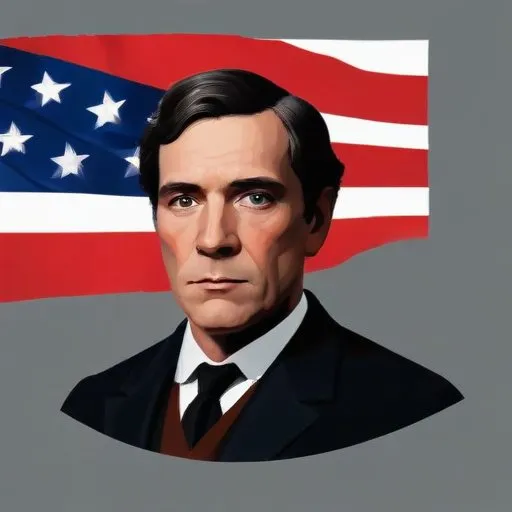
A Leader of the Confederacy: Alexander H. Stephens
Vice President of the Confederate States
Alexander H. Stephens is best known for his role as the first and only vice president of the Confederate States of America, serving from 1861 to 1865. He was a prominent figure in the American Civil War, advocating for the expansion of slavery and states' rights.
A Life of Politics and Service
Born on February 11, 1812, in Crawfordville, Georgia, Stephens was raised in a family of modest means. Despite the challenges he faced, he was an exceptional student and went on to attend Franklin College. After completing his education, he established a successful legal practice in his hometown and soon became involved in local politics.
Stephens served in both houses of the Georgia General Assembly before being elected to the United States House of Representatives in 1843. As a member of the Democratic Party, he became a leading Southern Whig, strongly opposing the Mexican-American War. His commitment to states' rights and the expansion of slavery led him to support the Compromise of 1850 and the Kansas-Nebraska Act.
The Cornerstone Speech
One of Stephens' most notable achievements was his Cornerstone Speech, delivered in March 1861. In this speech, he defended the institution of slavery, highlighting the fundamental differences between the American and Confederate constitutions. This speech laid out the Confederacy's rationale for seceding from the United States and solidified Stephens' position as a leading figure in the Confederacy.
Criticism and Controversy
Despite his dedication to the Confederacy, Stephens became increasingly critical of President
Jefferson Davis' policies, particularly regarding conscription and the suspension of habeas corpus. This criticism led to tensions between Stephens and Davis, ultimately weakening their relationship.
Later Life and Legacy
After the Civil War, Stephens returned to Georgia and resumed his legal practice. He was later elected as the 50th governor of Georgia, serving from 1882 until his death in 1883. Stephens passed away on March 4, 1883, leaving behind a complex legacy as a champion of states' rights and a defender of slavery.
Quotes and Memorable Sayings
- "Our new government is founded upon exactly the opposite idea; its foundations are laid, its cornerstone rests, upon the great truth that the negro is not equal to the white man; that slavery—subordination to the superior race—is his natural and normal condition."
- "The negro is in every way better off here than in any other country, and our Institution of Slavery is the very best thing that has ever happened to him."
Historical Context and Legacy
Stephens' life and legacy must be viewed within the context of the tumultuous period in which he lived. While his defense of slavery and states' rights is widely condemned today, it is essential to understand the historical context in which he operated. Stephens' complex and often contradictory views on slavery, states' rights, and the role of government continue to be debated among historians and scholars.
Influence on Modern Society
Stephens' legacy extends beyond the Civil War era, as his ideas about states' rights and the role of government continue to influence American politics. While his views on slavery are widely rejected, his commitment to regional identity and decentralized governance remains an essential part of the American political landscape.
FAQ
What was Alexander H. Stephens role in the American Civil War?
Alexander H. Stephens served as the Vice President of the Confederate States of America during the American Civil War. He was a strong supporter of states rights and secession, and his views were influential in shaping Confederate policy.
What was Alexander H. Stephens relationship like with Jefferson Davis?
Alexander H. Stephens had a complex and often tumultuous relationship with Jefferson Davis, the President of the Confederate States. While the two men shared similar views on secession and states rights, they often clashed over issues of policy and strategy.
What was Alexander H. Stephens view on slavery?
Alexander H. Stephens was a strong supporter of slavery, believing it to be a necessary institution for the Southern economy. However, he also believed that slavery would eventually be abolished, and he worked to find ways to preserve the institution while also acknowledging its moral complexities.
What were Alexander H. Stephens views on states rights?
Alexander H. Stephens was a strong believer in states rights, arguing that individual states should have greater control over their own affairs. He saw the Civil War as a struggle for states rights, rather than a fight to preserve slavery.
What is Alexander H. Stephens legacy in American history?
Alexander H. Stephens legacy in American history is that of a complex and often controversial figure. While he was a strong supporter of the Confederacy and slavery, he also worked to find ways to preserve the Union and acknowledge the moral complexities of slavery.