


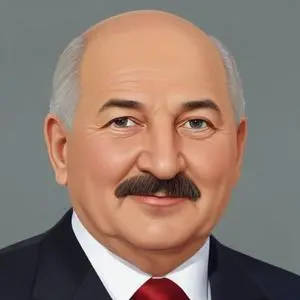
The authoritarian leader of Belarus since 1994, known for his iron grip on power and human rights abuses. He's been dubbed "Europe's last dictator" by some.
Alexander Lukashenko is a name synonymous with Belarusian politics, having held the office of President since 1994, making him the longest-serving European president. With a tenure spanning over two decades, Lukashenko has become an integral part of Belarusian history, navigating the country through the post-Soviet era.
Born on August 30, 1954, in Kopys, Vitebsk Region, Belarus, Lukashenko's early life was marked by a strong sense of patriotism and dedication to public service. Before entering politics, he worked as a director of a state farm (sovkhoz) and served in the Soviet Border Troops and the Soviet Army.
In 1990, Lukashenko was elected to the Supreme Soviet of the Byelorussian Soviet Socialist Republic, marking the beginning of his political career. Following the dissolution of the Soviet Union, he assumed the position of head of the interim anticorruption committee of the Supreme Council of Belarus.
In 1994, Lukashenko won the presidency in Belarus' inaugural presidential election, adopting a new constitution. He opposed economic shock therapy during the post-Soviet transition, maintaining state ownership of key industries in Belarus. This decision spared the country from devastating recessions that plagued other post-Soviet states and the former Eastern Bloc countries, preventing the rise of oligarchy.
Lukashenko's maintenance of a socialist economic model has been accompanied by an authoritarian government, earning him the label of "Europe's last dictator" from the media. International monitors have not regarded Belarusian elections as free and fair, except for his initial win. The government's suppression of opponents and limitation of media freedom have resulted in multiple Western governments imposing sanctions on Lukashenko and other Belarusian officials.
Lukashenko's regime has retained Soviet-era symbolism, including the Russian language, coat of arms, and national flag, which were adopted after a controversial 1995 referendum. This move has been seen as a testament to his commitment to Belarusian national identity and its historical ties to Russia.
Alexander Lukashenko's presidency has been marked by a mix of controversy and stability, with his regime maintaining a tight grip on power. While critics argue that his authoritarian rule has curtailed democratic freedoms, his supporters credit him with preserving Belarusian national identity and economic stability in the face of post-Soviet turmoil.
Lukashenko is known for his strong personality and love for sports, particularly ice hockey and football. He has two sons, Viktor and Nikolai, and has been married to Galina Zhelnerovich since 1975.
As the longest-serving European president, Alexander Lukashenko's legacy is complex and multifaceted, with both critics and supporters acknowledging his indelible mark on Belarusian history.
74 Years Old
A Russian politician who has dominated the country's politics for over two decades, known for his authoritarian leadership style and controversial foreign policy decisions.
61 Years Old
Russian lawyer and politician who served as President of Russia from 2008 to 2012, known for his efforts to modernize Russia's economy and politics. He also served as Prime Minister from 2012 to 2020.
76 Years Old
A Ukrainian engineer-turned-politician who served as President of Ukraine from 2010 to 2014, known for his pro-Russian stance and fleeing the country amidst protests.
88 Years Old
Ukraine's second president, an engineer-turned-politician, known for navigating the country's post-Soviet transition and implementing economic reforms. He's also infamous for his alleged role in a journalist's murder.
Born in 1906
A Soviet leader who ruled with an iron fist, implementing policies that stagnated the economy and suppressed dissent, while also being a key figure in the Cold War. He's infamous for his authoritarian regime and bureaucratic inefficiency.
Born in 1878
The Soviet Union's ruthless leader who ruled with an iron fist, implementing policies that led to widespread famine and purges, while also playing a crucial role in defeating Nazi Germany in World War II.
95 Years Old
The last leader of the Soviet Union, who introduced reforms that led to the end of the Cold War and the collapse of communism, earning a Nobel Peace Prize. He's known for his policies of glasnost and perestroika, which transformed the Soviet Union and the world.
Born in 1911
The charismatic leader who championed conservative policies, helped end the Cold War, and is often credited with restoring American pride and optimism. He's also remembered for his folksy, actor-honed communication style.
