


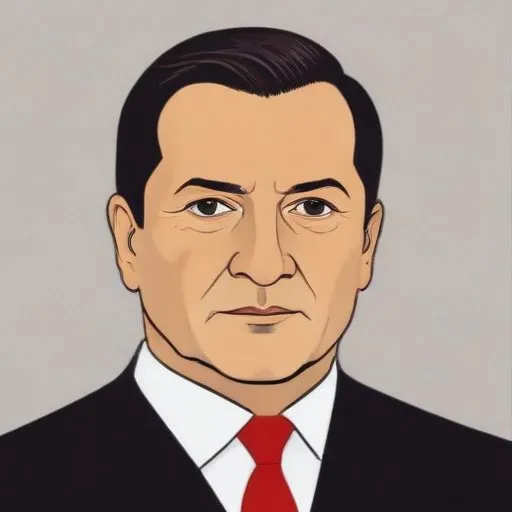
Romanian politician who served as Prime Minister of Romania, known for his role in the country's interwar period and his advocacy for Transylvanian autonomy.
Alexandru Vaida-Voevod was a pioneering Romanian politician who played a pivotal role in shaping the country's modern landscape. He is best known for his relentless advocacy for the union of Transylvania with the Romanian Kingdom, which ultimately led to the formation of Greater Romania in 1918.
Vaida-Voevod was born on February 27, 1872, in the village of Olpret, which was then part of Austria-Hungary (now Boblna, Romania). He hailed from a Greek-Catholic family and was raised in a region characterized by cultural and linguistic diversity. His formative years would later influence his political ideology, particularly his support for national self-determination.
In 1906, Vaida-Voevod joined the Romanian National Party of Transylvania and Banat, becoming a vocal opponent of the Hungarian government's Magyarization policy. He fought tirelessly for the rights of Transylvanians, advocating for their autonomy and self-determination within the Austro-Hungarian Empire.
In October 1918, Vaida-Voevod's perspective on the political landscape shifted dramatically. After reading about Woodrow Wilson's Fourteen Points in a Munich newspaper, he realized that the federalization of Austria-Hungary was no longer a viable solution. Instead, he turned his attention to uniting Transylvania with the Romanian Kingdom, drafting a proposal that would become the cornerstone of his political career.
Vaida-Voevod's efforts ultimately led to the Great Union of 1918, which united Transylvania, Banat, Crișana, Maramureș, and Bukovina with the Romanian Kingdom. This historic milestone was achieved through his collaboration with other prominent Romanian politicians, including Iuliu Hossu and Vasile Goldiș.
Vaida-Voevod went on to serve as the 28th Prime Minister of Romania, playing a key role in shaping the country's modern identity. His commitment to national unity and self-determination earned him a reputation as a visionary leader and a champion of Romanian rights.
Vaida-Voevod's political ideology was deeply rooted in his belief in national self-determination and the importance of cultural preservation. He was a strong advocate for decentralization and regional autonomy, recognizing the diversity of the Romanian people and their right to self-governance.
Vaida-Voevod's legacy extends far beyond his own lifetime. His tireless advocacy for national unity and self-determination paved the way for the modern Romanian state, inspiring generations of politicians and citizens alike. His commitment to regional autonomy and decentralization continues to shape the country's political landscape.
Vaida-Voevod's political ideology and commitment to national self-determination can be compared to that of other prominent regional leaders of the time, including Tomáš Masaryk of Czechoslovakia and Antonín Švehla of Bohemia. While their specific contexts differed, they shared a common goal of promoting national unity and autonomy within the Austro-Hungarian Empire.
Alexandru Vaida-Voevod's remarkable life and career serve as a testament to the power of vision, determination, and leadership. His unwavering commitment to the Romanian people and their right to self-determination continues to inspire and motivate generations, cementing his place as one of the most important figures in Romanian history.
96 Years Old
A Romanian engineer and politician who served as the country's second president, playing a key role in the country's transition from communism to democracy. He's known for his efforts to reform the economy and bring Romania into the European community.
86 Years Old
A Romanian academic and politician who served as the country's President from 1996 to 2000, known for his efforts to reform and democratize Romania after the fall of communism. He played a key role in Romania's transition to a market economy and its integration into European structures.
74 Years Old
Romanian captain and politician who served as the 4th President of Romania, known for his efforts to combat corruption and reform the country's political system. He was also a vocal critic of communism and worked to strengthen Romania's ties with the European Union.
67 Years Old
A Romanian educator and politician who served as the 5th President of Romania, known for promoting European integration and fighting corruption. He's a strong advocate for education and minority rights.
