


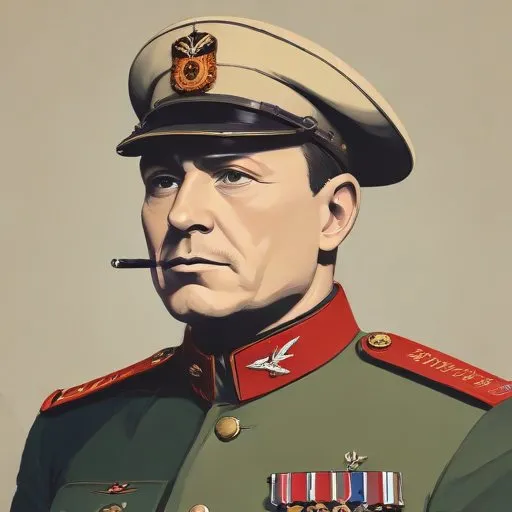
Estonian colonel who fought against the Soviet Union and Nazi Germany during World War II, and later became a prominent figure in the Estonian resistance movement.
Alfons Vilhelm Robert Rebane is renowned as the most highly decorated Estonian military officer during World War II, serving in various Wehrmacht and Waffen-SS units of Nazi Germany. His remarkable career spanned from fighting against the Soviet occupation to working with the British Secret Intelligence Service (MI6) to resist Soviet rule in Estonia and other Baltic countries.
Born on June 24, 1908, in Valga, southern Estonia, then part of the Governorate of Livonia of the Russian Empire, Rebane was the son of a railway official. He attended the Russian secondary school in Narva and later graduated from Tartu University. In 1929, he graduated from the Estonian Military Academy with first-class honors.
Rebane served as an infantry officer on the armored train Captain Irv of the 1st Armored Train Regiment as a second lieutenant in 1929. He was promoted to first lieutenant on Estonian Independence Day, February 24, 1933. Between 1935 and 1939, he served as a junior instructor in the Defence League Viljandi County Territorial Regiment, and later in the Lääne County Territorial Regiment from 1939 to 1940. In January 1940, he became the Commandant of Lihula.
When the Soviet Union occupied Estonia in 1940, Rebane's military career took a significant turn. He joined the German Wehrmacht and later the Waffen-SS, where he rose through the ranks, earning numerous decorations for bravery. His decision to collaborate with the Nazis remains a subject of controversy, with some viewing it as a necessary evil to resist Soviet occupation, while others condemn it as a morally reprehensible choice.
After World War II, Rebane joined the British Secret Intelligence Service (MI6), playing a key role in assisting the armed resistance to Soviet rule in Estonia and other Baltic countries. He led the Estonian portion of MI6's Operation Jungle well into the 1950s, utilizing his expertise to support anti-Soviet operations.
In 1961, Rebane retired from the British intelligence services and moved to Germany, where he stayed until his death on March 8, 1976, in Augsburg. The 1999 reburial of Rebane in Estonia with state honors sparked controversy, with some viewing it as a gesture of national recognition, while others criticized it as glorification of a Nazi collaborator.
Alfons Rebane's remarkable military career, marked by bravery and controversy, continues to evoke strong emotions and spark debates. While his collaboration with the Nazis remains a subject of criticism, his contributions to the Estonian resistance against Soviet rule are undeniable, earning him a place in the annals of Estonian history.
Born in 1890
Leader of Estonia's government-in-exile during World War II, fighting for independence from Soviet occupation. Known for his efforts to preserve Estonian sovereignty and culture.
Born in 1917
Estonian freedom fighter and forest brother who resisted Soviet occupation, leading a guerrilla war in the 1940s and 1950s. He is a national hero in Estonia for his bravery and sacrifice.
Born in 1914
Estonian poet and translator who introduced European modernism to Estonian literature and translated works of prominent authors like Rainer Maria Rilke and Thomas Mann. Known for his lyrical and expressive poetry that explored themes of love, nature, and existential crisis.
Born in 1890
A prominent Estonian leader who served as the country's Prime Minister during a tumultuous period, guiding Estonia through World War II and the Soviet occupation. He's revered for his bravery and statesmanship during Estonia's struggle for independence.
Born in 1884
A prominent military leader who played a crucial role in Estonia's struggle for independence, leading the country's armed forces to victory in the Estonian War of Independence.
