


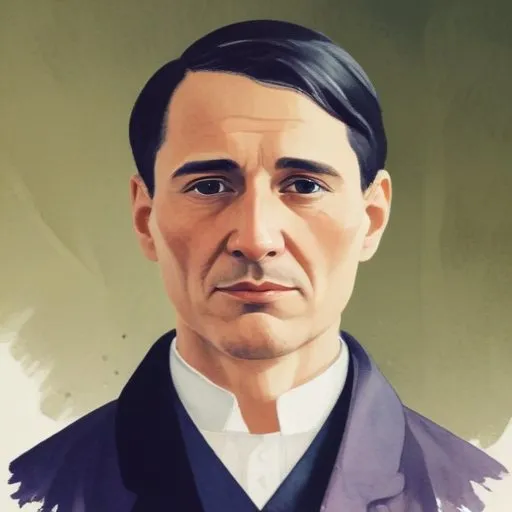
Estonian poet and translator who introduced European modernism to Estonian literature and translated works of prominent authors like Rainer Maria Rilke and Thomas Mann. Known for his lyrical and expressive poetry that explored themes of love, nature, and existential crisis.
August Sang, born on July 27, 1914, was an Estonian poet and literary translator, renowned for his contributions to Estonian literature and his translations of poetry from German, Russian, French, and Czech languages.
Sang was born in Prnu, Estonia, to Jakob and Akelina Sang (née Mellikov). He was the eldest of three brothers, Ilmar and Endel. After completing high school in 1932, Sang went on to study at the Philosophical Faculty of the University of Tartu from 1934 to 1942, although he had to interrupt his studies several times to earn a living.
Sang's literary journey began at the tender age of eight, when he started writing his own poetry. Under the pseudonym Injo, he participated in a literary competition run by the youth magazine Kevad in 1934, with his quick-tempoed poem "Improvisatsioon". This marked the beginning of his successful literary career.
In 1936, Sang made his debut in the literary arts magazine Looming, and his collection of poems "Ks noormees otsib nne" was published, which earned him his breakthrough. He went on to write numerous reviews and essays on literature, solidifying his position as a prominent figure in Estonian literature.
In the late 1930s, Sang joined the Arbujad circle, a group of esteemed poets and authors, including Bernard Kangro, Uku Masing, Kersti Merilaas, Betti Alver, Mart Raud, Heiti Talvik, and Paul Viiding. This literary circle played a significant role in shaping Estonian poetry before the outbreak of World War II.
In 1936, Sang married the Estonian poet and translator Kersti Merilaas, and the couple had a son, Joel Sang, in 1950. Sang's personal life was deeply intertwined with his literary career, as his wife was also a prominent member of the Arbujad circle.
After the Soviet occupation of Estonia, Sang joined the Soviet Estonia Writers Union in 1945, but was expelled in 1950. He was only permitted to work as a writer again in 1955, and subsequently rejoined the Writers Union a year later. Sang passed away on October 14, 1969, at the age of 55, in Tallinn.
August Sang's contributions to Estonian literature are immeasurable. His poetry and translations have left an indelible mark on the country's literary landscape. Through his work, Sang has inspired generations of Estonian writers and poets, and his legacy continues to be celebrated and honored to this day.
Born in 1803
Estonian physician and author who collected and published Estonian folklore, including the national epic "Kalevipoeg", which helped to establish Estonian as a literary language.
Born in 1843
Estonian poet and playwright who wrote about love, nature, and social issues, and is considered the founder of Estonian theatre.
Born in 1798
Estonian physician, philologist, and academic who contributed to the development of the Estonian language and literature, and was a key figure in the Estonian national awakening
Born in 1841
Estonian journalist and politician who advocated for Estonian independence from Russia and was a key figure in the country's struggle for self-governance. He's known for his passionate writings and speeches that inspired a nation.
Born in 1878
Estonia's national writer, known for his five-part novel "Truth and Justice", which is considered one of the greatest works of Estonian literature, offering a sweeping portrayal of Estonian life and society.
55 Years Old
Estonian fantasy and horror writer, known for his dark, atmospheric, and often surreal short stories that blend elements of mythology and folklore. His works have been translated into multiple languages and have gained a cult following.
