


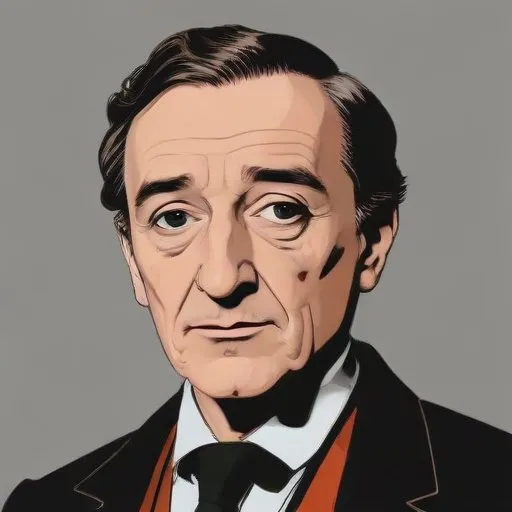
A Victorian-era wordsmith who penned poetry, plays, and novels, earning a brief stint as Poet Laureate of the United Kingdom.
Alfred Austin was an English poet who rose to prominence in the late 19th century, earning the esteemed title of Poet Laureate in 1896. His appointment was preceded by a lull following the death of Tennyson, as other candidates either sparked controversy or declined the honor, paving the way for Austin's ascension.
Austin was born on May 30, 1835, in Headingley, near Leeds, to a Roman Catholic family. His father, Joseph Austin, was a merchant, and his mother was a sister of Joseph Locke, a civil engineer and Member of Parliament for Honiton. Austin received his education at Stonyhurst College in Clitheroe, Lancashire, St Mary's College in Oscott, and the University of London, graduating in 1853.
Austin initially pursued a career in law, becoming a barrister in 1857. However, after inheriting a fortune from his uncle, he abandoned his legal career to focus on literature. He also dabbled in politics, running as a Conservative Party candidate for Taunton in 1865 and Dewsbury in 1880, although he was unsuccessful in both attempts.
Austin's literary career was marked by his editorial roles in various publications. Between 1866 and 1896, he edited the National Review and wrote leading articles for The Standard. He was also a foreign affairs correspondent, covering significant events such as the Ecumenical Council of the Vatican in 1870, the Franco-Prussian War, and the Congress of Berlin.
Austin was an ardent imperialist and follower of Disraeli, which is reflected in his writings. He became joint editor of the National Review with W. J. Courthope in 1883 and later became the sole editor from 1887 until 1896.
Upon Tennyson's death in 1892, Austin was eventually appointed as the new Poet Laureate in 1896. The decision was reportedly influenced by his support for Lord Salisbury in the General Election of 1895. Despite his mixed reputation, Austin held the position until his death in 1913.
Austin's poetry has largely fallen into obscurity, with many critics considering it mediocre. Wilfred Scawen Blunt famously remarked, "He is an acute and ready reasoner, and is well read in theology and science. It is strange his poetry should be such poor stuff, and stranger still that he should imagine it immortal."
However, Austin's prose idylls, which celebrated nature, remain his most popular works. Despite his questionable literary prowess, Austin's contributions to journalism and his imperialist views remain a significant part of his legacy.
Austin married in 1865 and had three sons. He died on June 2, 1913, leaving behind a mixed legacy as a poet, journalist, and imperialist.
Austin's life and career may be marked by controversy and mixed opinions, but his impact on the literary and journalistic world of his time remains undeniable.
Born in 1809
Poet laureate of the United Kingdom during much of Queen Victoria's reign, famous for patriotic and romantic poems like "In Memoriam A.H.H." and "The Charge of the Light Brigade".
Born in 1812
A Victorian-era literary giant, renowned for crafting intricate, psychologically nuanced poetry and plays that probed the human condition, often exploring themes of love, death, and the nature of existence.
Born in 1806
A renowned poet and translator of the Victorian era, celebrated for her romantic and socially conscious works, particularly the iconic love poems "Sonnets from the Portuguese".
Born in 1830
A renowned Victorian-era poet and author, celebrated for her lyrical and symbolic poetry, particularly "The Goblin Market and Other Poems" and "The Prince's Progress".
Born in 1828
A Victorian-era poet and painter who founded the Pre-Raphaelite Brotherhood, creating dreamlike, sensual works that explored themes of love, beauty, and mortality.
Born in 1770
A major Romantic poet, known for his focus on nature, emotion, and the human experience, creating works that evoke a sense of wonder and connection to the natural world.
Born in 1795
Romantic poet celebrated for sensual language and vivid imagery, capturing the beauty of nature and human experience in odes like "To Autumn" and "Ode to a Nightingale".
Born in 1792
Romantic-era writer of lyrical poetry and Gothic dramas that explored the human condition, freedom, and the beauty of nature.
