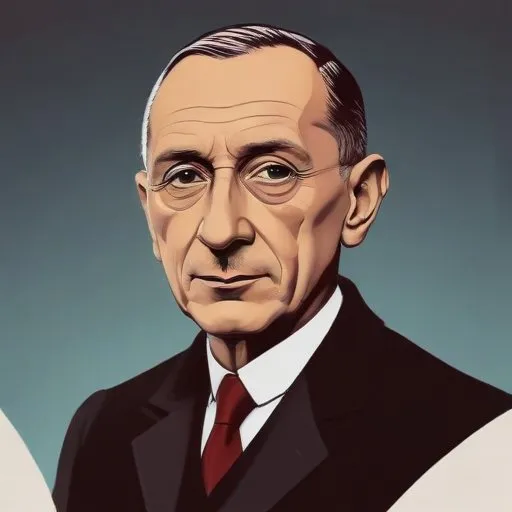
Alfred Perot: The Visionary Physicist Behind the Fabry-Perot Interferometer
A Legacy in Physics
Alfred Perot, a French physicist, is renowned for his groundbreaking work in the development of the Fabry-Perot interferometer, a crucial tool in the field of optics. Alongside his colleague
Charles Fabry, Perot designed and built this innovative instrument in 1899, which has since become a cornerstone in the study of light and its properties.
Early Life and Education
Born on November 3, 1863, in Metz, France, Perot's fascination with the natural world was evident from an early age. He pursued his passion for physics at the École Normale Supérieure in Paris, where he earned his degree in 1887.
Career Highlights and Major Works
Perot's most notable contribution to the scientific community is undoubtedly the Fabry-Perot interferometer. This innovative device consists of two mirrors placed parallel to each other, with a small gap in between. The interferometer uses the principle of interference to measure the wavelength of light with unprecedented precision. This invention has had a profound impact on various fields, including astronomy, spectroscopy, and laser technology.
Awards and Honors
Perot's outstanding work was recognized with several prestigious awards, including the Janssen Medal in 1912, awarded by the French Academy of Sciences. In 1918, the Royal Society honored him and Fabry with the Rumford Medal for their pioneering work in the field of optics.
Personal Milestones and Key Life Events
Perot's life was marked by a strong sense of dedication to his work and a passion for discovery. He was known for his meticulous attention to detail and his ability to approach complex problems with a logical and analytical mind.
Philosophical Contributions and Beliefs
Perot's work was guided by a deep understanding of the fundamental principles of physics and a commitment to advancing human knowledge. His contributions to the field of optics have had a lasting impact, paving the way for future generations of scientists and researchers.
Influence on Modern Society
The Fabry-Perot interferometer has far-reaching implications in various aspects of modern life, from the development of laser technology to the study of the universe. Perot's invention has enabled scientists to make precise measurements, leading to breakthroughs in fields such as astronomy, medicine, and telecommunications.
Legacy and Impact
Alfred Perot's legacy extends beyond his groundbreaking work on the Fabry-Perot interferometer. He has inspired generations of scientists and researchers, leaving behind a rich heritage of knowledge and innovation. His contributions to the field of physics have had a profound and lasting impact on our understanding of the world around us.
Trivia and Fun Facts
- Perot's last name is often spelled "Prot" in scientific publications, but according to the French civil registry, his family name was actually "Perot" without the accent.
- Perot was a prolific writer and published numerous papers on his research in prominent scientific journals.
Conclusion
Alfred Perot's remarkable journey is a testament to the power of human ingenuity and the importance of pursuing one's passion. His groundbreaking work on the Fabry-Perot interferometer has left an indelible mark on the field of physics, and his legacy continues to inspire and motivate scientists and researchers around the world.
FAQ
What are the contributions of Alfred Perot in the field of physics?
Alfred Perot was a French physicist who made significant contributions to the study of optics and spectroscopy. He is known for his work on the Perot-Fabry interferometer, which is still widely used today in various fields such as optics, spectroscopy, and lasers.
What is the Perot-Fabry interferometer used for?
The Perot-Fabry interferometer is an optical instrument used to measure the spectral lines of light with high accuracy. It has applications in various fields, including astronomy, chemistry, and material science.
What awards did Alfred Perot receive for his work?
Alfred Perot was awarded the Henry Draper Medal in 1924 for his contributions to the field of physics. He was also elected as a member of the French Academy of Sciences in 1925.
What is Alfred Perots educational background?
Alfred Perot studied at the École Normale Supérieure in Paris, where he obtained his degree in physics. He later pursued his doctorate at the University of Paris.
What is Alfred Perots legacy in the scientific community?
Alfred Perots work on the Perot-Fabry interferometer has had a lasting impact on the field of physics. His contributions have paved the way for further research in optics and spectroscopy, and his legacy continues to inspire scientists today.