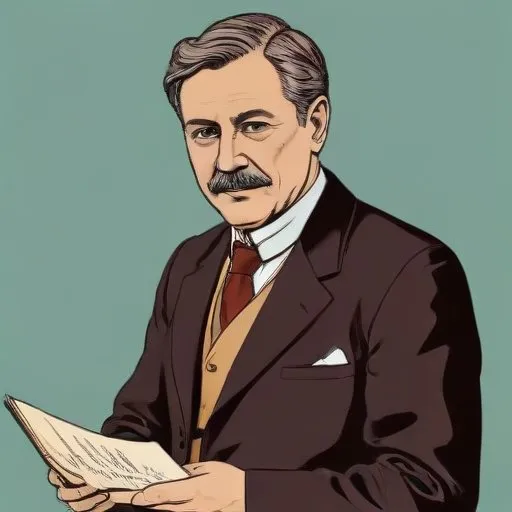
The Father of Racial Hygiene: Alfred Ploetz
Alfred Ploetz, a German physician and biologist, is widely recognized for coining the term "racial hygiene" (Rassenhygiene) and promoting eugenics in Germany. This concept, rooted in Social Darwinism, aimed to improve the human race through selective breeding and genetic engineering.
Early Life and Influences
Born on August 22, 1860, in Swinemünde, Germany (now Świnoujście, Poland), Ploetz grew up and attended school in Breslau (now Wrocław). His early friendships with notable figures, including Carl Hauptmann, brother of the famous author
Gerhart Hauptmann, shaped his intellectual and philosophical views.
The Formative Years
In 1879, Ploetz founded a secret racial youth society, demonstrating his early interest in eugenics and racial improvement. During this period, he studied political economy in Breslau, where he joined the Free Scientific Union, an organization that promoted the works of
Ernst Haeckel and Charles Darwin.
Fleeing Persecution
Due to the anti-socialist laws of
Otto von Bismarck, Ploetz fled to Zurich in 1883, where he continued his studies in political economy under Julius Platter. In Zurich, he deepened his understanding of socialist theories, which would later influence his eugenicist ideas.
The Concept of Racial Hygiene
Ploetz's magnum opus, "The Excellence of Our Race and the Protection of the Weak" (Die Tüchtigkeit unserer Rasse und der Schutz der Schwachen), published in 1895, introduced the concept of racial hygiene. This work emphasized the importance of selective breeding, forced sterilization, and the elimination of "undesirable" traits to improve the human race.
Legacy and Controversy
Ploetz's ideas, although influential in the development of eugenics, have been widely criticized for their fascist and racist undertones. His work has been linked to the atrocities of the Nazi regime, which adopted and implemented similar eugenic policies during World War II.
Personal Life and Milestones
Ploetz's personal life was marked by significant events, including his friendship with Gerhart Hauptmann, whose drama "Before Sunrise" (Vor Sonnenaufgang) was inspired by Ploetz's life and ideas. He also spent time in the United States, where he was influenced by the American eugenics movement.
Philosophical Contributions and Beliefs
Ploetz's work was rooted in Social Darwinism, which posits that human societies evolve through natural selection. He believed that only the "fit" should reproduce, while the "unfit" should be prevented from doing so. This ideology has been widely discredited as discriminatory and dehumanizing.
Impact on Modern Society
Ploetz's ideas have had a lasting, albeit controversial, impact on modern society. His work has influenced the development of genetic engineering, reproductive rights, and disability rights. However, his legacy serves as a cautionary tale about the dangers of unchecked scientific hubris and the importance of ethical considerations in scientific inquiry.
Quotes and Memorable Sayings
- "The goal of racial hygiene is to breed a superior humanity, freed from the burden of the weak and the inferior." - Alfred Ploetz
Historical Context and Legacy
Ploetz's life and work are inextricably linked to the tumultuous early 20th century, marked by World War I and the rise of fascist regimes. His ideas, although flawed and dangerous, offer a unique window into the complex and often troubling history of scientific thought and its intersection with politics and morality.
FAQ
Who was Alfred Ploetz and what were his contributions to eugenics?
Alfred Ploetz was a German physician, biologist, and eugenicist who founded the German Society for Racial Hygiene in 1905. He was a key figure in the development of eugenics and racial hygiene in Germany.
What were Alfred Ploetzs views on racial hygiene and eugenics?
Ploetz believed in the importance of improving the human race through selective breeding and the elimination of inferior genetic traits. His ideas were later adopted by the Nazi party and used to justify their eugenic policies.
How did Alfred Ploetz influence the development of eugenics in Germany?
Ploetzs work helped to popularize eugenic ideas in Germany, influencing politicians, scientists, and medical professionals. His ideas were later used to justify forced sterilization and other eugenic policies.
What were Alfred Ploetzs views on the role of medicine in society?
Ploetz believed that medicine should play a central role in promoting social hygiene and improving the health of the population. He advocated for state-sponsored health programs and the use of medicine to promote eugenic goals.
Is Alfred Ploetzs legacy controversial due to his association with Nazism?
Yes, Ploetzs legacy is highly controversial due to his association with the Nazi party and their use of his eugenic ideas to justify their policies of forced sterilization, internment, and genocide.