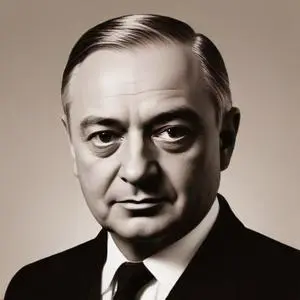
Alfred Rosenberg: The Architect of Nazi Ideology
Theoretical Mastermind Behind the Nazi Regime
Alfred Rosenberg was a Baltic German Nazi theorist and ideologue who played a pivotal role in shaping the ideology of the Nazi Party. As the author of the seminal work "The Myth of the Twentieth Century" (1930), Rosenberg is considered one of the main authors of key Nazi ideological creeds, including its racial theory, anti-Semitism, and opposition to modern art.
Early Life and Family
Rosenberg was born on January 12, 1893, in Reval, Estonia (then part of the Russian Empire), to Elfriede (née Sir) and Friedrich August Sir. His mother had French and German ancestry, while his father was a railway official. Rosenberg's family moved to Moscow during his childhood, where he developed a fascination with philosophy and literature.
Rise to Prominence
Rosenberg's introduction to
Adolf Hitler by
Dietrich Eckart marked the beginning of his rise to prominence within the Nazi Party. He held several important posts in the Nazi government, including the head of the NSDAP Office of Foreign Affairs (1933-1945) and the leader of Amt Rosenberg, an official Nazi body for cultural policy and surveillance, between 1934 and 1945.
Key Contributions and Beliefs
Rosenberg's work, "The Myth of the Twentieth Century," outlined the Nazi Party's racial theory, emphasizing the superiority of the "Aryan" race. He also advocated for the need for Lebensraum (living space) and the rejection of modern art, which he deemed "degenerate." Rosenberg's beliefs were heavily influenced by his rejection of Christianity, and he played a significant role in the development of German nationalist Positive Christianity, which denied Jesus as the Messiah and rejected the Old Testament.
Reich Ministry for the Occupied Eastern Territories
During World War II, Rosenberg served as the head of the Reich Ministry for the Occupied Eastern Territories (1941-1945), overseeing the administration of occupied territories in Eastern Europe.
Nuremberg Trials and Execution
After the war, Rosenberg was convicted of crimes against peace, planning, initiating, and waging wars of aggression, war crimes, and crimes against humanity at the Nuremberg trials in 1946. He was sentenced to death by hanging and executed on October 16, 1946.
Legacy and Impact
Rosenberg's work had a profound impact on the development of Nazi ideology, shaping the party's beliefs on race, anti-Semitism, and modern art. His influence on modern society is undeniable, serving as a stark reminder of the dangers of extremist ideologies.
Quotes and Memorable Sayings
- "The myth of the twentieth century is the myth of blood, the belief that the god-creating priestly thinkers of the Aryans have the sacred mission of dedicating all the other races to the service of the Aryan will to power."
- "The war is not being fought against the German people, but against the poison of Jewry."
Historical Context and Comparative Analysis
Rosenberg's work and ideology must be viewed within the context of the interwar period, where nationalist and fascist movements were on the rise across Europe. His beliefs were heavily influenced by the prevailing anti-Semitic sentiment and nationalist fervor of the time.
Final Thoughts
Alfred Rosenberg's legacy serves as a testament to the dangers of extremist ideologies and the importance of promoting tolerance, understanding, and critical thinking. His contributions to Nazi ideology continue to shape our understanding of the Third Reich and its devastating impact on humanity.
FAQ
What was Alfred Rosenbergs role in Nazi Germany?
Alfred Rosenberg was a German politician and architect who served as the Reich Minister for the Occupied Eastern Territories during World War II. He was a key figure in the Nazi regime and played a significant role in implementing Nazi ideology.
What were Alfred Rosenbergs contributions to Nazi ideology?
Alfred Rosenberg was a leading ideologue of the Nazi Party, responsible for developing and promoting the partys racial and anti-Semitic ideology. He was a strong advocate for the notion of blood and soil.
What was Alfred Rosenbergs role in the occupation of Eastern Europe?
Alfred Rosenberg oversaw the Nazi occupation of Eastern Europe, including the administration of conquered territories and the implementation of Nazi policies, such as the Holocaust.
How was Alfred Rosenberg implicated in war crimes?
Alfred Rosenberg was convicted of war crimes and crimes against humanity at the Nuremberg Trials, where he was held responsible for his role in the Nazi regimes atrocities.
What was Alfred Rosenbergs fate?
Alfred Rosenberg was executed by hanging on October 16, 1946, for his role in the Nazi regimes war crimes and atrocities.